
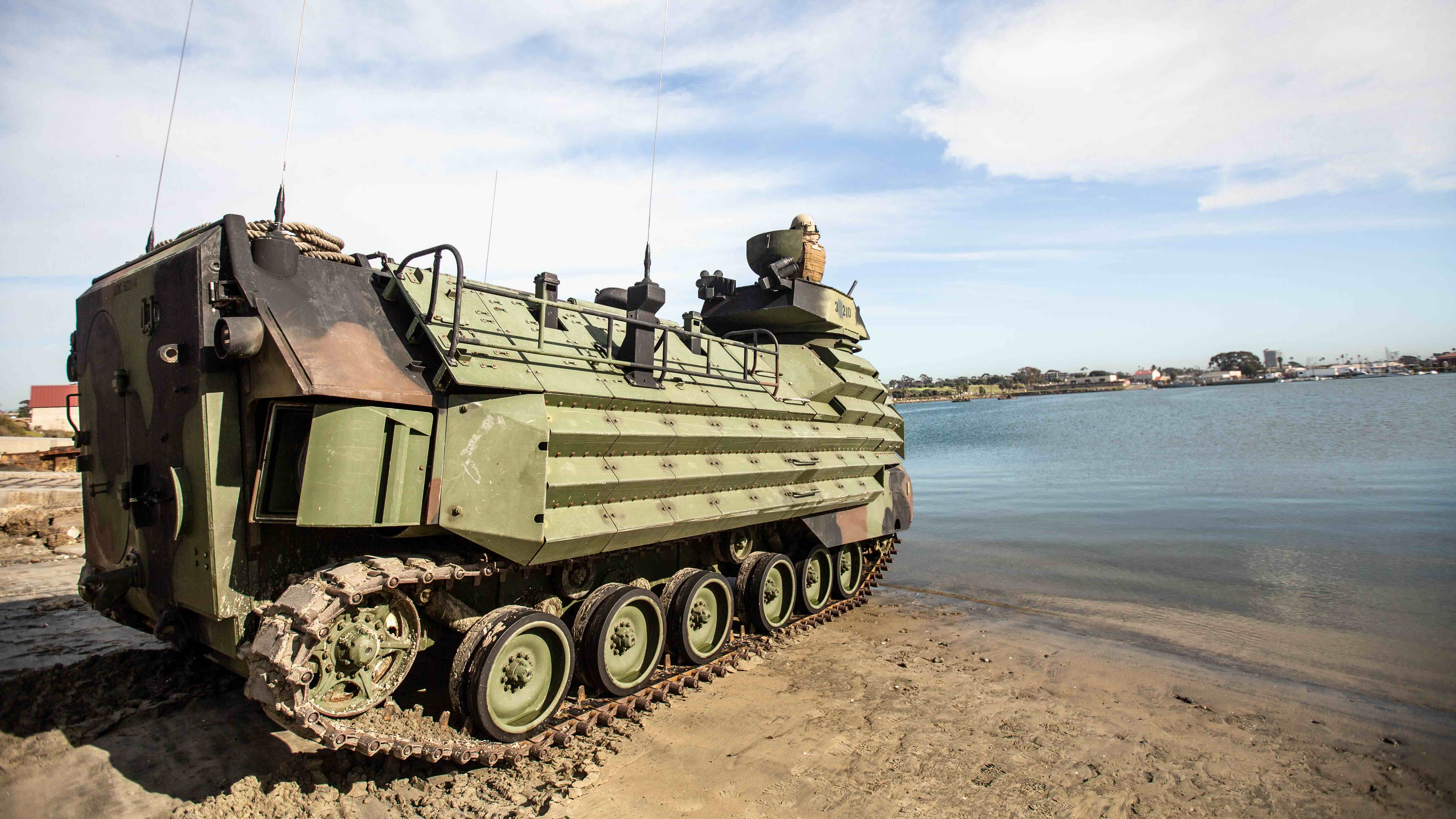
The U.S. Marine Corps officially retired its Assault Amphibious Vehicle (AAV), closing a 50-year chapter of amphibious operations that carried Marines from ship to shore across the globe.
According to a Marine Corps press release, the decommissioning ceremony held on Sept. 26 at Camp Pendleton’s Assault Amphibian School honored both the vehicle and the Marines who operated it.
“We’re sad to see the AAV go,” said Col. Lynn W. Berendsen, the school’s commanding officer. “It was a workhorse.”
First fielded in 1972 as the Landing Vehicle, Tracked, Personnel-7 (LVTP-7) under a $78.5 million contract with American defense company United Defense, the 30-ton tracked vehicle replaced the Vietnam-era LVT.
Its amphibious armor, water jet propulsion, and troop capacity made it central to Marine operations in Grenada, the Gulf War, Iraq, and humanitarian missions such as Hurricane Katrina.
Service life extension programs in the 1980s upgraded the vehicles with new engines, transmissions, and weapon stations, leading to their redesignation as the AAV-7A1. Over the years, the AAVs have received further enhancements to meet evolving operational requirements.
However, despite the upgrades, in 2018, service officials decided it was time to retire the workhorse, replacing it with a more modern vehicle better suited for expeditionary and large-scale combat operations.
Berendsen, who operated AAVs in Fallujah in 2005, said the platform’s reliability was unmatched.
“The AAV-P7 has been many things, a ship to shore connector, an armored fighting vehicle, a troop carrier, a logistics platform and even sometimes a live boat,” Berendsen said. “Most importantly, it was in a place where Marines made their mark in combat, in service and in sacrifice.”
AAVs are gradually being replaced by a newer, eight-wheeled model called the Amphibious Combat Vehicle, which has been operational for several years.







Dangerous job. That vehicle served multiple roles. From beach landing to having Air and artillery observers walking in fire mission
Sad day for Marines past and present around the world. I spent 7 months in one of these, training and sweating for 4 days of “combat” during the Gulf War. This machine was also a death trap, as 9 Marines drowned off Del Mar Beach Camp Pendleton Coast 3 years ago, and the Department of Navy still can’t figure out why…
As a former mech of aavs, I will miss being knee deep in seawater leaking in, mixed with puking Marines