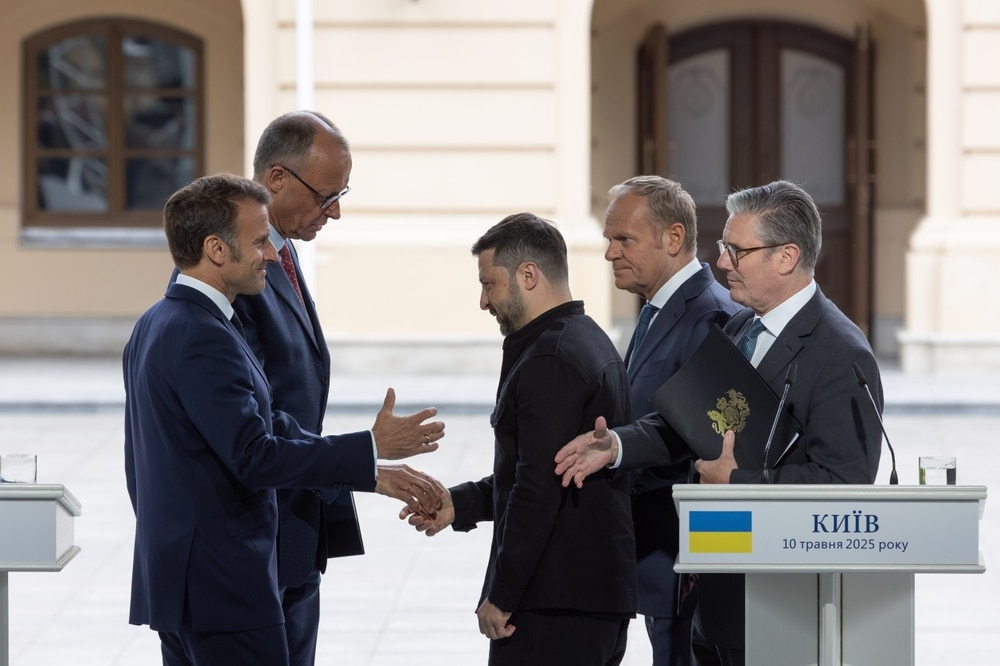
Twenty-six nations committed Thursday to deploy a “reassurance force” in post-war Ukraine to deter future Russian aggression, French President Emmanuel Macron announced following a summit in Paris.
The coalition pledged to maintain a presence “by land, sea or air” once fighting ends, Macron said alongside Ukrainian President Volodymyr Zelenskyy. The force aims “to prevent any new major aggression and to involve the 26 states very clearly in the lasting security of Ukraine,” but “does not have the will or the objective of waging war against Russia,” Macron stated.
Thirty-five nations participated in the summit, meeting with Zelenskyy and U.S. envoy Steve Witkoff. Macron said planning “will be finalized with the United States,” describing American participation as essential. Both leaders confirmed Washington’s willingness to support the plan, though details remain unclear.
British Prime Minister Keir Starmer, who co-leads the coalition, said the group made an “unbreakable pledge” to Ukraine. The coalition includes Canada, Australia and Japan alongside European nations, with plans for expanded Ukrainian force training and troop deployments away from front lines.
Just yesterday, SOFX reported that Sweden’s Defense Minister Pål Jonson told Breaking Defense this week that Stockholm is open to supplying Gripen E fighter jets to Ukraine after the war ends, with older Gripen C/D aircraft potentially available sooner.
Zelenskyy called the commitments a “serious concrete step.” NATO Secretary-General Mark Rutte supported the initiative and dismissed Russian President Vladimir Putin’s objections to foreign troops in Ukraine.
Following a video call with President Donald Trump, European leaders emphasized economic pressure on Russia. Trump stressed that European nations must stop purchasing Russian oil, noting Russia received €1.1 billion in EU fuel sales last year.
The European Commission proposed phasing out EU imports of Russian oil and gas by January 1, 2028.
Despite security commitments, peace prospects remain limited. European officials said Putin shows little interest in negotiations, citing his recent Beijing visit as evidence he is preparing for prolonged conflict.