
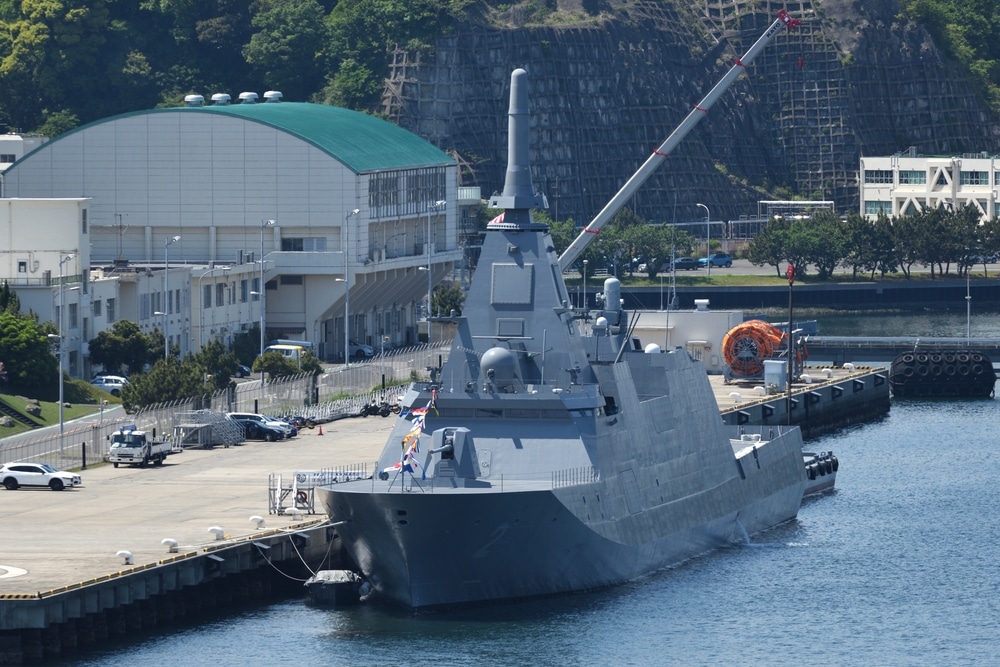
Japan and Australia executed four defense agreements in Melbourne on Saturday, formalizing the first three Mogami-class frigates for the Royal Australian Navy alongside a separate anti-air warfare systems contract, an intelligence-sharing pact on Australia’s MQ-28A Ghost Bat loyal wingman drone, and a cyberdefense letter of intent.
Koizumi called the frigate purchase a “major step” in elevating bilateral defense ties and described it as Japan’s largest defense export in its postwar history.
A stronger Australia-Japan partnership, built at sea. Australia has signed contracts for its first three General Purpose Frigates, based on Japan’s upgraded Mogami‑class design by MHI. The Mogami Memorandum deepens defence and industry cooperation. https://t.co/cFEtQBlOh7
— Andrew Shearerアンドリュー・シーラー (@AusAmbJPN) April 19, 2026
Defence Ministers Richard Marles and Shinjiro Koizumi signed the contracts aboard the Japan Maritime Self-Defense Force (JMSDF) Mogami-class frigate JS Kumano, in port following the ship’s participation in Exercise Kakadu, a multinational maritime drill.
On Apr 18, DM Koizumi and Richard Marles MP, Deputy Prime Minister and Minister for @DefenceAust attended the Ceremony for the Signing of Contractsfor Australia’s General Purpose Frigate aboard JS Kumano, which was docked in Melbourne 🌸🦘
— Japan Ministry of Defense/Self-Defense Forces (@ModJapan_en) April 18, 2026
Both ministers also signed a “Mogami Memorandum” committing both governments to the program’s successful delivery and deeper defense-industrial cooperation.
The MOC on 🇯🇵🇦🇺 defense cooperation signed by both ministers reaffirms this project advances through close #PublicPrivateCollaboration🤝
JMOD will move forward with Japan’s defense industry as an All‑Japan effort. #FFM #Mogami #Sea3000 #AUJP50 #ContractSignedonSchedule pic.twitter.com/auaeHecpAv— Japan Ministry of Defense/Self-Defense Forces (@ModJapan_en) April 18, 2026
Mitsubishi Electric Corporation signed a separate contract with Australia’s Department of Defence the same day to supply anti-air warfare (AAW) systems for the fleet. The value of that contract was not disclosed.
“Our surface fleet is more important than at any time in decades,” Marles said. “These frigates will be the backbone of continuous naval shipbuilding in Western Australia.”
Mitsubishi Heavy Industries (MHI) will build the first three vessels at its Nagasaki Shipyard and Machinery Works, with delivery of the first scheduled for December 2029 and entry into service in 2030. Austal will build the remaining eight at the Henderson shipyard in Western Australia.
Each upgraded Mogami carries a 32-cell vertical launch system (VLS), is armed with surface-to-air and anti-ship missiles, has a range of 10,000 nautical miles, and operates with a crew of 92 and an MH-60R Seahawk maritime helicopter.
The agreement is only Japan’s second export of a complete defense system since Tokyo eased arms export restrictions in 2014. Tokyo plans to scrap as early as next week a rule limiting military sales to five noncombat categories, a move Marles called “important” for building a “seamless defense-industrial base.”
Koizumi confirmed New Zealand has “strong interest” in the Mogami class, with media reports placing it against the British Type 31 frigate as Wellington’s top two options for replacing its own Anzac-class fleet.
Indonesia has also expressed interest in the design, while the Philippines is separately considering decommissioned JMSDF Abukuma-class destroyer escorts.