
BLUF: This paper kills the word courage and finds something larger standing where it stood. The argument seats Byron and Hemingway in one room. Byron located courage in manner, the bearing, the chosen ground, the brightness a man adds to the act, and insisted the difference between an upright death and a clutching one is the only thing that ever mattered. Then he died of marsh fever in a Missolonghi bed, having never fired a shot, and the legend formed over the corpse anyway, which is precisely his theory’s fatal flaw: he cannot tell courage from its appearance, because for him there is none. Hemingway supplies the colder truth. The trained man feels no fear at the moment of action because formation has amputated the imagination that builds the fear, closing the gap the classical definition required. No gap, no crossing, no courage. Searching the act and the formation alike turns up only necessity, situational in the one, the slow friction of habit in the other, never a brave instant anywhere. Witnesses add the word afterward, upgrading constraint into intention, as a notetaker almost certainly did when he gave Luther here I stand, I can do no other. The strongest opponent, that necessity is courage perfected rather than absent, dissolves on the same forged sentence.
And then the proven floor rings hollow. The emptied self is read a second way: not subtracted but emptied through, the contemplatives’ self given over so completely that necessity and freedom stop being two things. Byron, all ego and volume, could never pass through that door. Hemingway walked through it ten thousand times and called it craft. At the bottom of necessity, where the chooser is gone, there is no courage and no gap, only a man in a place he cannot leave doing the one thing left, ringing as he does it, a note true because nothing false remains to bend it.
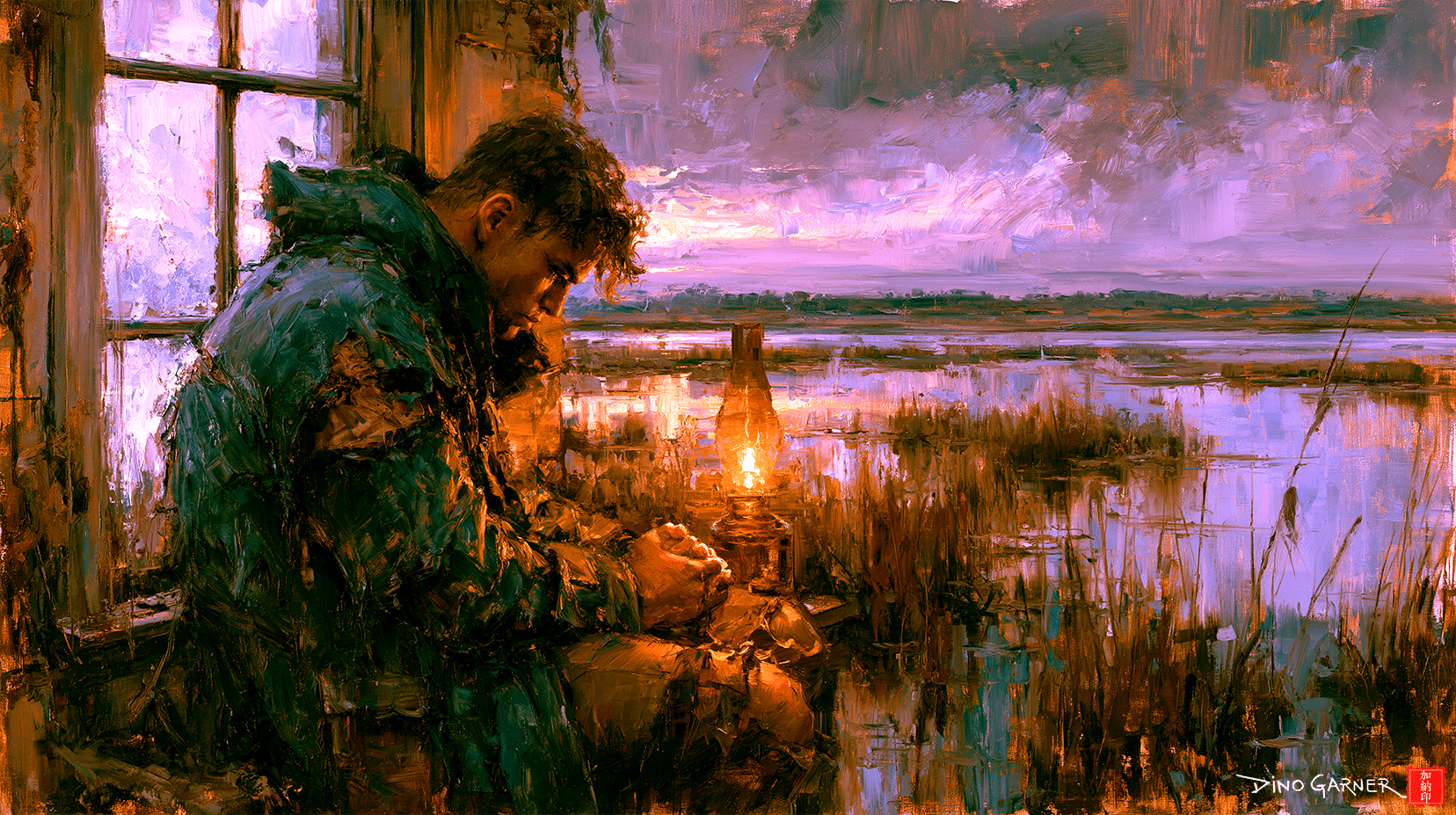
There is a marsh on the western coast of Greece where the air comes off the lagoon five months out of six and makes woful work with visiters, as one of them wrote in a letter long before he became the one the marsh would keep. Missolonghi. In the early spring of 1824, it held perhaps five thousand defenders, a few hundred mercenaries, an Italian-educated politician named Mavrokordatos, and an English lord who had spent four thousand pounds of his own money refitting the Greek fleet and who intended, when the rains let up, to lead an assault on the Turkish fortress at Lepanto. He had no military experience. He had taken command of a body of troops anyway. He had hired a fire-master for the artillery. He was thirty-six years old and he had come a very long way to die well.
He did not get the chance. Before the expedition could sail he fell ill, and the physicians who attended him bled him with leeches and lancets until the fever and the treatment together finished what the marsh began. On the nineteenth of April he died in bed. He never reached the field. He never fired a shot in the war he is remembered for dying in. The most famous soldier-poet of the age died of a mosquito and a misguided cure, and it did not matter at all, because the legend had already left the body and gone on without it.
Three months earlier, on his last birthday, in that same town, he had written himself an order in verse. We will come back to it, because it is the purest thing ever composed on the subject of this paper, and the most wrong. For now only this: the man who wrote seek out a soldier’s grave got a sickbed instead, and we have spent two hundred years pretending the difference is small. This paper is about why we do that. It is about the word courage, and the suspicion, which I will argue all the way to its cold conclusion, that the word names nothing, that there is no courage anywhere, that there are only men who have cut away their alternatives and men who have not, and a vast machinery of the living that turns the first kind into heroes after they can no longer object.
To argue it I am going to put two men in a room who never met and who would have disliked each other on contact. One of them believed the gesture was everything. The other spent his life cutting the gesture away until only the act remained, and then could not survive the silence he had made. Byron will lead, because the romance always leads. Hemingway will follow, because the truth usually arrives late, after the beautiful thing has finished speaking, and says less.
The Inheritance Both Men Came To Bury
Before either of them, there was Aristotle, and the definition the West has never quite escaped. In the Nicomachean Ethics courage is a mean between two vices, cowardice and rashness, and it is not the absence of fear but the right relation to it. The brave man feels what is fearful, judges it correctly, and acts because the action is noble. He is not fearless. A man who fears nothing is not brave but, in Aristotle’s word, a sort of madman. Courage requires that the danger be felt as danger and chosen against.
There is a line in that text that will indict one of our two men so precisely it could have been written for him. The brave man, Aristotle says, is keen in the moment of action, but quiet beforehand, while the rash man wishes for dangers beforehand but draws back when he is in them. Hold that thought against a poet who wrote his own death three months early, on his birthday, and then died in bed. We will need it.
The popular inheritance is simpler and even more demanding. It is the version on the posters, the one attributed to Mark Twain: courage is resistance to fear, mastery of fear, not absence of fear. Notice what this requires. For there to be courage there must be a gap: a felt fear on one side, an action on the other, and a self that crosses from one to the other under its own power. No gap, no crossing. No crossing, no courage. The entire edifice depends on the gap being real and being crossed by something we can name and praise.
Both of the men in our room deny the edifice. They deny it from opposite directions, and that is the whole drama. Byron denies that the gap matters, because for him what counts is the manner of the crossing, the style, the defiance, the brightness a man adds to the act. Hemingway denies that the gap exists at all for the man who has trained, because training is precisely the work of removing it. One inflates the moment past the point where fear could touch it. The other deflates the man past the point where fear could reach him. Between them they leave the classical definition with nothing to stand on. Let us hear them.
Byron: The Manner Is The Soul
Begin with him at full height, because he deserves it and because the fall is meaningless if we make him small first. George Gordon, sixth Baron Byron, was the most famous writer in Europe and had been since he awoke one morning and found himself famous at twenty-four. He was beautiful, lame, scandalous, and brave in the way the age understood bravery, which is to say theatrically and in public. When he went to Greece he did not go quietly. He designed a helmet. He spent his fortune. He wrote letters full of disgust at the squabbling Greek captains and stayed anyway. And on the twenty-second of January, 1824, he wrote the poem.
It is called “On This Day I Complete My Thirty-Sixth Year,” and it is a command issued by a man to himself. The first half is lament: the heart that can no longer move others, the days in the yellow leaf, the fire on the bosom lone as a volcanic isle. And then, at the turn, he refuses the lament and orders himself to the field. Tread those reviving passions down. If thou regret’st thy youth, why live? The land of honourable death is here. Seek out a soldier’s grave. Then look around, and choose thy ground, and take thy rest.
This is the romantic theory of courage in its most concentrated form, and it is genuinely magnificent, so let us state it as its own best advocate would. Byron’s claim is that necessity, even total necessity, does not exhaust the act. Suppose two men die taking the same hill. Suppose neither had any real choice, both swept forward by orders and circumstance and the impossibility of turning back. They are equally compelled. And yet one dies cursing and clutching, and one dies cold and upright, and Byron insists, with everything in him, that the difference between those two deaths is the only thing that has ever mattered. The body is a mechanism. The manner is the man. Courage is not whether you go forward, because the situation decides that. Courage is who you are while going.
There is real force here, and a reader feels it, because we do in fact distinguish those two deaths. We do honor the upright one. Byron has named something true about how human beings actually grade each other: not by outcomes, which fortune controls, but by bearing, which seems to be ours. He has located the self in the one place necessity cannot obviously reach, the style of the doing, and he has planted his flag there and dared anyone to take it.
But watch what the theory cannot do, and watch it in Byron’s own life, because he is about to demonstrate the flaw with his corpse. Byron cannot tell the difference between courage and the appearance of courage, because for him there is no difference. The manner is the thing. The look of the upright death is the upright death. And this means his theory has no defense whatever against the case where the manner arrives and the substance never does. Where a man composes the soldier’s grave in advance, perfects the bearing, publishes the defiance, and then dies of a fever in a bed having never once stood on the ground he chose so beautifully in verse.
That is exactly what happened. And here is the part that should trouble us, the part that makes Byron not merely wrong but dangerous: it worked anyway. The death by marsh fever became, in the retelling, a death for Greece. The first prime minister of independent Greece delivered a funeral oration that was translated and spread across Europe. Streets bear his name. An entire Athenian neighborhood is called Byrona. Delacroix painted from his poems. The man gave Greece his money and his fame and his death, and the fact that the death was involuntary, bacterial, and bedridden has been quietly sanded away by two centuries of people who needed the manner to be the man. Byron proved his own thesis. Romance can metabolize a pointless death into a glorious one. That is its function. That is what it is for.
Which is precisely why the other man in the room cannot stand him. Because Hemingway looked at exactly this operation, the upgrading of the ugly real thing into the beautiful told thing, and spent his life trying to cut it out of prose and out of men. He is leaning against the wall now, and he has heard enough.
Hemingway: Courage Is An Amputation
He does not argue with the poem. He never argues with poems. He just describes what the field is actually like for the man who is on it, which Byron, for all his helmet and his fire-master, never was. And his description is one of the coldest and truest things anyone has written about the inside of danger.
In 1942, editing an anthology of war writing, Hemingway set it down plainly. Cowardice, as distinguished from panic, is almost always simply a lack of ability to suspend the functioning of the imagination. And the corollary, the gift: learning to suspend your imagination and live completely in the very second of the present minute, with no before and no after, is the greatest thing a soldier can acquire.
Read that again, because it dismantles the classical definition without raising its voice. The coward is not the man who feels too much fear. The coward is the man who can still imagine. He can see the wound before it arrives, the widow, the dark, the alternative in which he lives by turning back. His imagination keeps the future open, and an open future is a set of choices, and one of those choices is survival. The so-called brave man has not mastered his fear in Aristotle’s sense. He has done something stranger and more surgical. He has amputated the faculty that produces the fear. He has cut away the before and the after until only the present motion remains, and in a present with no future there is nothing to be afraid of and nothing to choose, because fear and choice both live in the future the imagination builds, and he has stopped building it.
This is the exiled self, and notice that it is the exact opposite of Byron’s. Byron adds: brightness, defiance, the volcanic fire, the chosen manner. Hemingway subtracts: the imagination, the future, the alternative, until what is left is a man, a task, and no audience and no second option. For Byron courage is a presence, something layered onto the act. For Hemingway the thing that looks like courage is an absence, a hole where the alternatives used to be, dug out in advance by training so that at the moment of action there is nothing left to be brave across. The gap that the whole classical edifice required, the space between felt fear and chosen action, has been filled in. There is no crossing because there is no gap. There is only the trained motion of a man who long ago removed the option of doing otherwise.
The Matador, And The Brave Actions Of A Coward
Hemingway worked this out most fully not in war but in the bullring, watching men do a dangerous and technical thing for money in front of a crowd that could tell, instantly, the real thing from its imitation. In Death in the Afternoon he is explicit, and he draws our distinction in his own words. The brave actions of a coward are very valuable in psychological novels, but they are not valuable to the public who pay to see a bullfighter. The coward in the ring, driven by fear and the need to survive the afternoon, will sometimes produce a maneuver that looks like valor. The crowd is not fooled. They have paid, season after season, to see something else, and they know the difference between a man whose fear is driving him and a man whose craft is.
And craft, for Hemingway, is not courage either. It is knowledge plus the suspension of imagination. There is always something the matador can do if he keeps his nerve; he may sweat ink, but there is a way to fight each bull no matter how difficult. That is not bravery. That is the trained certainty that a path exists, and the foreclosed discipline to walk it without letting the imagination open the door marked otherwise. He even gives us the counter-example, the great matador Rafael El Gallo, all grace and superstition, whose artistry the crowd loved and whose underlying cowardice they also saw. The grace and the cowardice coexisted in one man. The manner and the substance came apart, in plain view, which is the one thing Byron’s theory swears cannot happen.
The Cruelty Under The Whole Argument
Now the line that turns this from a theory of courage into the engine of this entire paper, and that explains why these two men had to be the ones in the room. After Hemingway describes the soldier’s gift of suspending the imagination, he adds, almost as an aside, that this gift is the opposite of all those gifts a writer should have. The soldier amputates the imagination. The writer cultivates it. They are contradictory vocations. The thing that lets you act on the field is the thing that, if you keep it, makes you unable to stop seeing the field afterward, in the dark, for the rest of your life.
Which means Byron, the writer, the man of pure imagination, was constitutionally incapable of the thing he wrote so beautifully about. His imagination was magnificent and it never stopped, and an imagination that never stops cannot suspend the before and after, cannot close the gap, cannot do what the trained soldier does. He could compose the soldier’s grave precisely because he could never occupy it. And Hemingway, who tried his whole life to be both the man on the field and the man who writes it down, knew the two could not finally be reconciled, that the war ends where the writing begins, and that a person who insists on doing both will be torn along the seam between them. He was describing his own fault line. We will see, at the end, where it broke.
The Relocation That Fails
Here a sympathetic reader, and I count myself one, tries to save the word. If courage is not in the act, the reader says, because the trained man has closed the gap, then perhaps we have simply been looking in the wrong place. Perhaps the courage is earlier. Perhaps it lives in the formation, in the years of becoming someone for whom the alternatives are excluded. The bravery was spent in advance, in the long labor of cutting the options away, and what we see on the field is only its residue. The act is necessity, yes. But the becoming was courage. Relocate the virtue from the moment to the making, and the word survives.
It is a tempting move and I want it to work and it does not work. Look closely at the formation and ask where, in it, the brave instant is. A man enlists. He is trained, drilled, broken down and rebuilt. He runs the drill ten thousand times until the rifle is part of his hands and the movement happens below thought. None of this felt like courage at any point. The recruit on the third week of a tedious exercise is not being brave. He is being bored, and tired, and obedient. The repetitions that bar his alternatives are, one by one, utterly ordinary. There is no single rep across which he leaps a chasm of fear. The foreclosure is built the way a callus is built, by friction, gradually, without a heroic moment anywhere in the process.
So the relocation fails by the same logic that emptied the act. The act contains no courage because the gap has been closed. The formation contains no courage because it is just accumulated ordinary friction, no gap in any single rep either. We have now looked in both places the virtue could live, the moment and the making, and found in each only necessity: situational necessity in the act, the slow necessity of habit in the formation. The word courage was supposed to name a specific thing that happens at a specific time when a specific self crosses a specific gap. We have checked every time and every place and the gap is never there. Either it was closed in advance by training, or it is being closed gradually by habituation, but it is never open at the moment we look. And a crossing of a gap that is never open is not a crossing. It is not anything. The word names a thing that, when examined at any actual instant, is not occurring.
Attribution Drift: The Word Was Never Found, It Was Added
If courage is nowhere in the act and nowhere in the formation, one question remains, and it is the most important one. Why are we so sure it exists? Why does every culture have the word, the medals, the oration, the street named after the man who died of fever? The answer is the deepest finding of this paper, and it is not a fact about courage. It is a fact about witnesses. We do not observe courage. We add it, afterward, to the record of a necessity, because we need the actor to have chosen what he merely could not avoid. Call it attribution drift: the systematic upgrading of constraint into intention by the people who tell the story later.
The cleanest proof is in the title of this paper. Here I stand, I can do no other. Words that the West has carried for five hundred years as the very monument of moral courage, Martin Luther before the Diet of Worms in 1521, refusing to recant, alone against the assembled power of empire and church. Except that the line is, by the judgment of historians, almost certainly something Luther did not say. The contemporaneous transcripts do not agree. The words appear in some printed versions and are absent from others, and one strand of scholarship concludes that the notetaker added them, in a well-intentioned effort to bolster the public’s perception of Luther’s courage and piety.
Sit with what that means. The single most famous sentence of heroic necessity in our entire civilization, the sentence we reach for when we mean a person stood firm because they had become someone who could not do otherwise, is very likely a forgery of exactly the kind this paper describes. Someone in the room watched a man do a necessary thing, and then, writing it down, could not leave it as necessity. He reached in and added the manner. He gave Luther the upright bearing, the chosen ground, the defiance, the Byronic line, after the fact, to make the record braver than the record was. It is Byron’s hand reaching into the transcript. The romance did not observe the courage. It supplied it.
And it happened to the other man in our room too, against his explicit wishes, which is almost too perfect. Everyone knows that Hemingway defined courage as grace under pressure. It is on the posters and the greeting cards. He did not. What he actually wrote, in a 1926 letter to Fitzgerald, was that he was not referring to guts but to something else: grace under pressure. He was drawing a distinction, carefully, between two things, and grace was the cold technical one, the economy of motion, the absence of waste. The culture took his careful distinction, threw away the distinction, welded the word courage onto it, and turned the most anti-romantic writer of the century into an inspirational slogan. The exact operation he spent his life resisting was performed on his own sentence. The romance came for him too. It comes for everyone. That is the point. It is not a flaw in particular tellings. It is what telling does.
Devil’s Advocate: That Necessity Is Not The Death Of Courage But Its Maturity
I have built the case to its coldest point and now I owe it the strongest possible answer, because a thesis that has not survived its best opponent has not earned its conclusion. And there is a serious opponent, one that uses my own central word against me, and it deserves to be stated at full strength rather than knocked down as a straw figure.
The opponent grants almost everything. Yes, says this view, the phenomenology is exactly as you describe. Real people who perform the bravest acts report precisely that they had no choice. Study the rescuers: the analysis of Carnegie Hero Medal recipients found their acts were overwhelmingly intuitive, immediate, made without deliberation. They say, almost to a person, that they did not think, they simply acted. You are right that this is necessity, not a gap crossed by a calculating self. But you have drawn the wrong conclusion from it. The philosopher Bryan Smyth, building on Bernard Williams, argues that heroism is a form of nonselfsacrificial practical necessity, an action that flows from a self so deeply formed that the right deed is the only possible deed. The “I can do no other” is not the confession that there was no courage. It is courage in its highest and most complete form, so total that it no longer feels like effort. The coward is the one who still has to decide. The truly brave person has become someone for whom there is nothing left to decide, and that becoming is the whole moral achievement. You found necessity and declared the virtue absent. The opponent finds the same necessity and declares it the virtue perfected.
This is a real argument and it is the best one against me, and I concede its phenomenology completely. It is right about what the rescuers feel. It is right that maturity in any practice looks like effortlessness. It is right that we admire the person for whom the good has become second nature more, not less, than the person who must grit their teeth. If I am to hold my conclusion, I cannot deny any of that. I have to show that even granting all of it, the virtue still cannot be located, and that the opponent has only hidden the absence rather than filled it.
And here the case breaks, on a single move the opponent cannot avoid making and cannot survive having made. Watch it closely, because everything turns on it. Pressed to say where the courage is, the opponent could not point to the act, because the act is admittedly effortless necessity. So the opponent pointed to the formation, the becoming. But we have already walked through the formation, rep by rep, and found no brave instant in it, only ordinary friction. So the opponent does something subtler: the virtue is relocated not to any moment of the becoming but to the whole of it, to the deep bond, the embodied commitment, the formed character taken as a totality. And that is the move to watch, because it is an admission disguised as a discovery. The opponent has conceded that the courage is at no time and no place we can examine, not in the act, not in any rep of the training, and has then named the sum of all those courage-free moments “courage.” But a sum of instants in none of which a thing is present does not contain the thing. Calling the total “the bond” or “the formed self” does not conjure a virtue out of a series of ordinary necessities. It just gives the absence a dignified name.
And then the opponent’s own emblem turns in its hand. The highest expression of this mature necessity, the phrase the view would put on its banner, is here I stand, I can do no other. We have seen what that sentence is. It is very probably a thing Luther never said, added by a witness to make the record braver. The founding text of “necessity as the highest courage” is itself an instance of attribution drift, the very mechanism by which I claim the word gets manufactured. The opponent reaches for the purest proof that mature necessity is courage, and the proof dissolves into exactly the forgery my thesis predicts. The strongest case for the word turns out to rest on a sentence somebody added because the truth, necessity plainly stated, was not stirring enough to leave alone.
The virtue is not in the act. It is not in any moment of the making. It is not in the sum of the making, which is only the absence given a name. And the one sentence that supposedly captures it best was inserted after the fact by the romance itself. I have looked everywhere a thing could be and it is not anywhere. There is no courage. There is necessity, and there is the hand that writes courage in the margin afterward, so that we can bear it.
The Door
And here the paper should end, on the cold and finished floor, and for the length of a held breath I believed it would. The word is dead. The Devil’s Advocate is beaten on his own ground. There is no courage, only necessity and the hand that gilds it. That is the whole of the argument and the argument is airtight. But a floor proven solid is also a floor, and a thing I did not expect happened when I stood on it and listened, which is that it rang, and a thing that rings is hollow, and on the far side of the hollow there was a sound, and I have to follow the sound now even though it leaves the country of argument behind, because the argument was only ever the way down to the place where arguing stops.
Return to the man at the hill, the finished man, the one whose alternatives were cut away until only the necessary motion remained. We said he was emptied. We said the training hollowed him out, amputated the imagination that would have shown him the other roads, closed the gap that courage needed in order to exist. All of that is true and none of it is the whole truth, because there are two ways to read an emptiness and we have only read the cold one. The cold reading says: a man reduced to a mechanism, a self subtracted down to a reflex, a hole where the person used to be. And from the country of argument that reading is correct. But stand on the floor and listen to what is on the other side of it, and a second reading comes up through the boards, older than argument, in a vocabulary this paper has not yet been permitted to speak.
The man was not emptied out. He was emptied through. The cutting away of every alternative until one motion remains is, read from the cold side, a subtraction, a loss, a man made less. Read from the far side it is the exact shape of a thing the contemplatives spent their lives trying to describe and could only ever point at, the self emptied of itself, the will given over so completely that it is no longer the man’s own will doing the deed. Not I, but something through me. The bow that has forgotten it is being drawn. The dancer who has vanished into the dance until there is only dancing and no one left who dances. Meister Eckhart had a word for it, gelassenheit, a releasement, a letting-go so total that the self stops standing in its own way.
The Gita had a phrase for it, action performed without attachment to its fruit, the deed done perfectly because the doer has dissolved out of it. These are not metaphors imported to decorate the cold finding. They are the same finding, read from the other side of the floor. Necessity perfected is not the absence of freedom. It is the place freedom and necessity stop being two things, because there is no longer a self standing apart from the act to feel the difference between what it must do and what it chooses. The gap did not close into a mechanism. It closed into a unity. And we, holding our cold instruments on the near side, measured the closing and called it loss, because loss is the only thing our instruments can read.
Hold this against the two men, because it judges them again, and the second judgment reverses the first without canceling it. Byron wanted the self magnified. The manner, the brightness, the volcanic isle blazing for the watchers, the ego at the full volume of its defiance. Everything in him reached to make the self larger, louder, more visible against the dark. And that is precisely why the door was always shut to him: he stood in front of it being magnificent, and a self that large cannot pass through an opening whose only key is its own disappearance. Byron could compose the threshold in deathless verse and could never cross it, not because he lacked courage, there being no such thing to lack, but because crossing required the one thing his whole art existed to prevent, the vanishing of the one who crosses. He is not the counterexample to the sacred. He is its exact inverse, the self so committed to being a self that it can never be given away.
And Hemingway walked through it without ever knowing it was a door. This is the thing I was not prepared to find and cannot stop seeing now. The whole cold apparatus of his doctrine, the suspension of the imagination, the present second with no before and no after, the foreclosure of every alternative until only the trained motion remains, he built it as a craft, a technique, a hard practical knowledge of how a man keeps working under fire. He thought he was describing marksmanship. He was describing annihilation, the emptying of the self that the mystics climbed mountains and starved in cells to reach, and he reached it lying still in a blind waiting for light, and he called it grace under pressure, and he was right, he was more right than he could bear to know, because grace is the word, grace in the oldest and most dangerous sense, the gift that arrives only in the place the self has been cleared away to receive it. He was a mystic who believed he was a technician. He performed the disappearance of the self ten thousand times on paper and in the field and never once let himself call it what it was, because to call it that would have been to admit that the thing he most distrusted, the thing he spent a lifetime stripping out of prose, was the thing he had been practicing all along.
And now the sentence turns in the hand a final time, the forged one, the one we stole for the title. Here I stand, I can do no other. We proved it false. A notetaker added it to make a plain refusal look like chosen valor, the very engine of attribution drift caught in the act at the highest seat of the Western record, and everything we said about that is true and stays true. But watch what the forger reached for in the dark of his good intentions. Trying to inflate the man into a hero, groping for the most stirring thing a brave man could say, he wrote, without knowing it, the most precise description of the sacred emptiness ever set down: a man reporting that the self which would choose has fallen silent, that there is no other road, not because the roads were taken from him but because the one who would walk another has dissolved, and only the necessary remains, and the necessary is now the whole of him.
The forger meant to write courage. His hand wrote its disappearance into the thing past it. He lied to make Luther brave and told, by accident, the deepest truth in the language: that at the bottom of necessity, where the self is finally cut all the way through, there is no courage and there is no chooser and there is no gap, there is only a man standing in a place he cannot leave, doing the one thing left to do, and ringing, as he does it, with a note that is true precisely because it could be no other note. The false sentence is the true one. It was always the true one. We just had to kill the meaning everyone gave it before the meaning it never knew it had could be heard.
Two Graves
Let me end where the argument has been pointing the whole time, at two graves, and let me drop the cold voice for a moment, because what is left when you take the word away is not triumph. It is grief, and the two men earned an honest share of it.
Byron is buried in England, having died in the marsh he chose for its glory and received without its battle. He is the writer, the imagination that never stopped, the man who could compose the soldier’s grave precisely because he could never lie down in it. He got his fever and his leeches and his bed, and then he got, undeservedly and inevitably, his legend, because the living needed the manner to be the man and supplied the rest. He is, in the end, the most sympathetic figure in this paper, because he believed his own poem. He really did sail to Greece. He really did spend the fortune and stay among the squabbling captains and mean to lead the assault. The romance was not cynical in him. It was sincere. He is the romance at its most honest, which is to say its most self-deceived, and there is something unbearably moving about a man dying of the wrong thing while the right thing waits three months away that will now never come.
Hemingway is buried in Idaho, and his death is the other half of the symmetry, the one that finishes the thought. He preached the suspension of the imagination, the present with no before and no after, the excluded self that does the necessary thing because the alternatives have been cut away. On the morning of the second of July, 1961, sick, broken by electroshock, unable any longer to do the writing that was the cultivation of the imagination, his memory going, his body wrecked by a life of crashes and concussions, he woke early, took the shotgun he had used so often it might have been a friend, walked to the foyer, and used it. Two shells. The one act with no before and no after. He performed his own definition to the end. Complete presence. No imagination of the morning that would follow, because he had spent a lifetime learning to suspend exactly that. The trained motion, the alternative amputated, necessity carried out with the economy he called grace. And here the cold reading and the far reading stand over the same body and refuse to resolve, and I will not force them to, because the whole burden of this paper is that they cannot be resolved from where we stand. The cold reading says a wrecked man performed the last subtraction and called it nothing because it was nothing.
The far reading says a man who had stood at the threshold his whole life, who had practiced the emptying ten thousand times and named it craft, finally crossed, the last alternative cut, the self that could imagine otherwise gone silent at last, and stepped through the door he had been leaning against since 1942 without ever once admitting it was a door. I cannot tell you which reading is true. I can tell you that from the far side of necessity the most terrible thing a man can do and the most holy thing a man can do may be the same motion seen from opposite shores, and that we are standing on the shore that can only see the terror, and that this, exactly this, is the limit of the cold instruments, the place where they go quiet because there is nothing left in their language to measure.
Neither death was courage. One was a fever wearing a laurel it did not earn. One was a craft wearing nothing at all, executed flawlessly, in silence, alone. And if you stand between the two graves and listen, the strange thing, the thing this whole paper has been circling, is that it is Byron you still hear. He is still talking. He never stops talking. He is composing the bearing, choosing the ground, treading the passions down, building the cathedral of the manner over the plain fact of the body in the bed. And Hemingway is not arguing with him. Hemingway, who was actually on the fields Byron only wrote, just looks at him, the way the man who knows looks at the man who only describes, and says nothing, because the silence is the whole of his answer and he has no other.
So we will keep the word, of course, because we cannot live on the far shore, we can only glimpse it across the water and come back. We will go on giving the medals and naming the streets and reaching into the transcripts to add the line, and now we know we are doing two things at once when we do it, hiding a truth and pointing at one, burying the necessity under the romance and, in the same buried sentence, preserving by accident the only true thing anyone ever said about what waits at the bottom of necessity. The man at the hill was not brave. He was finished. The man who froze beside him was not a coward. He was unfinished, with all his roads still open and every one of them a place to stand apart and choose, which is the thing the finished man no longer had and no longer was. We were right to kill the word. There is no courage. There never was. But we killed it the way you break a shell to see what is moving inside, and what was moving inside was not nothing, it was the thing the word had been built to hide from us, the thing too large and too quiet for a word that small.
Listen, then, the way the whole of this was an argument for listening, listening under the noise the tellers make, under the manner and the medal and the forged brave line, listening for the first sound a thing makes before anyone arrives to say what it means. There is a sound a self makes when it has been cut all the way through, when the last alternative falls away and there is no one left standing apart to be afraid, no chooser, no gap, no manner, nothing but the necessary motion and the man who has become it. It is not the sound of courage, courage being a word for people who still have roads. It is not Byron’s sound, the blaze, the cathedral, the volcano performing its magnificence against the dark. It is quieter than that and it goes further. It is the sound of the bow that has forgotten the hand. It is the note struck so clean that the bell vanishes into it and there is only the ringing, only the one tone that could be no other tone, true not because it is loud and not because it is brave but because there is nothing false left in it to muffle it, nothing of the self remaining to bend it off true. That is the sound this whole cold descent was cut to let us hear. A man standing where he cannot leave, doing the one thing left to do, ringing as he does it. Fire that has burned away everything that was not the thing itself, and rings, and is true.
Here I stand. I can do no other. We thought it was a lie about courage. It was a true thing about its disappearance, and the man who forged it heard the note without knowing what he was hearing, and wrote it down, and we have carried it five hundred years not knowing we were carrying the answer inside the counterfeit. There is no courage. There is only this. And this has no name in the language we came in speaking, because this is what is left when the speaker is gone.
RESONANCE
Aristotle, Nicomachean Ethics, Book III (Loeb / Internet Sacred Text Archive). Summary: The foundational definition the paper exists to dismantle: courage as the mean between cowardice and rashness, requiring fear correctly felt and chosen against, with the brave man keen in action but quiet beforehand and the rash man wishing for danger in advance, a line that indicts Byron directly.
Byron, “On This Day I Complete My Thirty-Sixth Year” (Coleridge/Prothero Works, Wikisource). Summary: Byron’s last poem, written at Missolonghi three months before his death, in which he orders himself to tread his passions down and seek a soldier’s grave: the romantic theory of courage in its most concentrated and self-deceived form.
Lord Byron, biographical record of the Greek campaign and death (Wikipedia). Summary: Confirms Byron planned the assault on Lepanto, took command without military experience, fell ill before the expedition could sail, was weakened by therapeutic bleeding, and died of fever on 19 April 1824 having never fought, the refutation of his own poem.
Lord Byron’s malaria and final illness (PMC, Journal of the medical record). Summary: Medical-historical analysis of Byron’s recurrent fever and the bloodletting that hastened his death, grounding the claim that the soldier-poet died of a marsh-borne disease and its treatment rather than in battle.
The afterlife of Byron’s death and the Greek funeral oration (The American Scholar). Summary: Documents how Byron’s fever death was transmuted into a death for Greece, with Trikoupis’s widely translated oration and the streets and neighborhood that bear his name: attribution drift operating on a national scale.
Hemingway, Introduction to Men at War, 1942 (text reproduced at Helytimes). Summary: The amputation thesis in Hemingway’s own words: cowardice as the failure to suspend the imagination, the soldier’s greatest gift as living with no before and no after, and the crucial admission that this gift is the opposite of the writer’s, the seam along which the paper’s close turns.
Hemingway, Death in the Afternoon, quotations (Bookey). Summary: Hemingway distinguishing the brave-looking actions of a coward from the real thing the paying crowd comes to see, the clearest statement in his own hand that the manner and the substance of courage come apart, contradicting Byron directly.
Hemingway’s “grace under pressure” and the Fitzgerald letter (Project MUSE, George Monteiro). Summary:Establishes that Hemingway was drawing a distinction, not defining courage, when he wrote grace under pressure, and that the popular collapse of that distinction into a courage slogan is itself an instance of the romanticizing the paper indicts.
The probable inauthenticity of “Here I stand, I can do no other” (Britannica; Concordia Publishing House). Summary:Britannica calls the line apocryphal and the transcripts disagree; one scholarly account holds the notetaker added it to bolster perception of Luther’s courage, making the paper’s title the purest specimen of attribution drift in the Western record.
Smyth, “Ich kann nicht anders: Social Heroism as Nonselfsacrificial Practical Necessity” (Frontiers in Psychology). Summary: The strongest opponent of the thesis: heroism as a practical necessity flowing from deep formation, the “I can do no other” read as courage perfected rather than absent, the case the Devil’s Advocate states at full strength before it is turned.
Rand et al., “Risking Your Life Without a Second Thought” (PMC). Summary: Empirical study of Carnegie Hero Medal recipients showing their acts were overwhelmingly intuitive and undeliberated, the evidence that the phenomenology of heroism really is necessity rather than a calculated crossing, which the paper concedes and then reinterprets.
Hemingway’s death, 2 July 1961 (Hemingway archival project, Omeka). Summary: The factual record of Hemingway’s final morning, the favorite shotgun and the foyer, grounding the paper’s closing claim that he performed his own definition of suspended imagination and foreclosed alternatives to the end.
Meister Eckhart on Gelassenheit and the emptied self (Hermitary, House of Solitude). Summary: The medieval source for the paper’s far reading: releasement as a letting-go so total that the will is handed over and the self stops standing in its own way, the emptying that the cold side measures as loss and the contemplative tradition names as the condition of grace.
The Bhagavad Gita on nishkama karma and the dissolution of the doer (Bhagavad Gita 2.47, holy-bhagavad-gita.org). Summary: Action performed without attachment to its fruit, the deed done perfectly because the doer has given up the pride of doership and dissolved out of it, an independent tradition arriving at the same place as the paper’s far reading: the act remains, the self that would claim it is gone.
The full disputed text at Worms, “God help me, here I stand” (Britannica). Summary: The sentence the paper steals for its title and turns twice: first exposed as probable forgery, the engine of attribution drift caught at the highest seat of the record, then recovered as the truest description of necessity ever set down, a man reporting that the self that would choose has gone silent and only the necessary remains.







I know that you have experienced courage in yourself and observed it in others. People cannot be trained to be courageous. Rather, I believe courage is an immediate inherent response to actions that would incapacitate most others. Courage is not dead or even failing. Courage will show as needed.
Thank you, Chuck. Your words illustrate an important lesson: we define our actions to reflect our own inner thoughts, ideas, beliefs, values and standards.
Mine was never courage. It was pure necessity. I gave myself no choice other than to live. And that meant doing whatever it took to get through the mission.
I don’t inject subjective or moral thoughts into my Equation of Necessity.
Courage is a moral issue. It’s very human. Under pressure, I am not human. I am something else entirely.
Cheers,
Dino