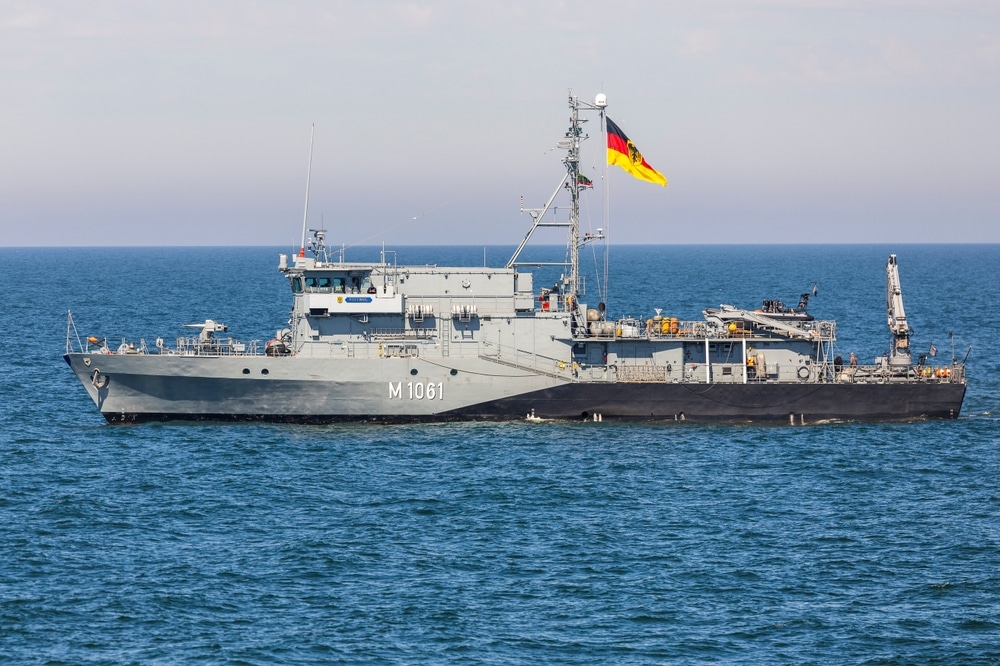
Germany is prepared to deploy Frankenthal-class (Type 332) minehunters to the Strait of Hormuz as part of an international security mission, with Chancellor Friedrich Merz set to present a formal offer at four-nation talks in Paris on Friday.
A German government official told reporters that Berlin is “prepared to make a German contribution to ensuring freedom of navigation,” covering mine clearance and maritime reconnaissance.
Germany is prepared to contribute minehunters to a potential mission to secure the Strait of Hormuz after the Iran war ends, sources say https://t.co/WFakccgpgU
— dpa news agency (@dpa_intl) April 16, 2026
Speaking Thursday after meeting Irish Prime Minister Micheál Martin in Berlin, Merz said Germany is ready to contribute but requires at minimum a provisional ceasefire, a collective security mandate from the United Nations or an equivalent framework, and formal approval from both the federal government and the Bundestag. “We are still a long way from that,” he said.
News: Germany is ready to deploy minesweepers and maritime reconnaissance planes to the Straight of Hormuz “to ensure freedom of navigation”, a German official tells me.
Plans will be discussed tomorrow in Paris — but in contrast to Macron, Merz wants to involve the U.S. in the…
— Hans von der Burchard (@vonderburchard) April 16, 2026
The Bundeswehr’s proposal, details of which were first reported by Süddeutsche Zeitung, would include Frankenthal-class minehunters exceeding 50 meters and crewed by 42 sailors, an escort ship, and reconnaissance aircraft.
🔴The German publication “Süddeutsche Zeitung” reported on Thursday, April 16, that Germany is ready to participate in a potential mission to secure the Strait of Hormuz by providing its expertise in mine clearance and maritime surveillance.
The report added that Friedrich Merz,…
— Alex kennedy (@Alexkennedy213) April 16, 2026
Germany operates eight minehunting boats and two mine-diving boats, though how many are deployable has not been confirmed.
The plan also envisions using Germany’s Djibouti logistics base for maritime reconnaissance and relieving NATO partners in the North Atlantic to free allied mine countermeasures (MCM) forces for the Hormuz mission, drawing existing capacity away from NATO’s own northern posture.
IEA Executive Director Fatih Birol warned Thursday that Europe has “maybe six weeks or so of jet fuel left” if supplies through the strait remain blocked, calling the situation “the largest energy crisis we have ever faced.”
The International Energy Agency’s chief warned Europe has roughly six weeks of jet fuel remaining, with flight cancellations expected soon. “We have maybe 6 weeks or so of jet fuel left,” he said. “I can tell you soon we will hear the news that some of the flights from City A to… pic.twitter.com/4jSQEhCHwZ
— 🚨Global Alert (@trendingnews911) April 16, 2026
The Middle East supplied 75% of Europe’s net jet fuel imports before hostilities began.
Traffic through the strait, which carried roughly 20% of global crude oil and liquefied natural gas before U.S.-Israeli strikes triggered the Iran war on February 28, has been almost completely blocked since.
Trump has pushed NATO allies for concrete Hormuz commitments within days, according to Secretary General Mark Rutte.