
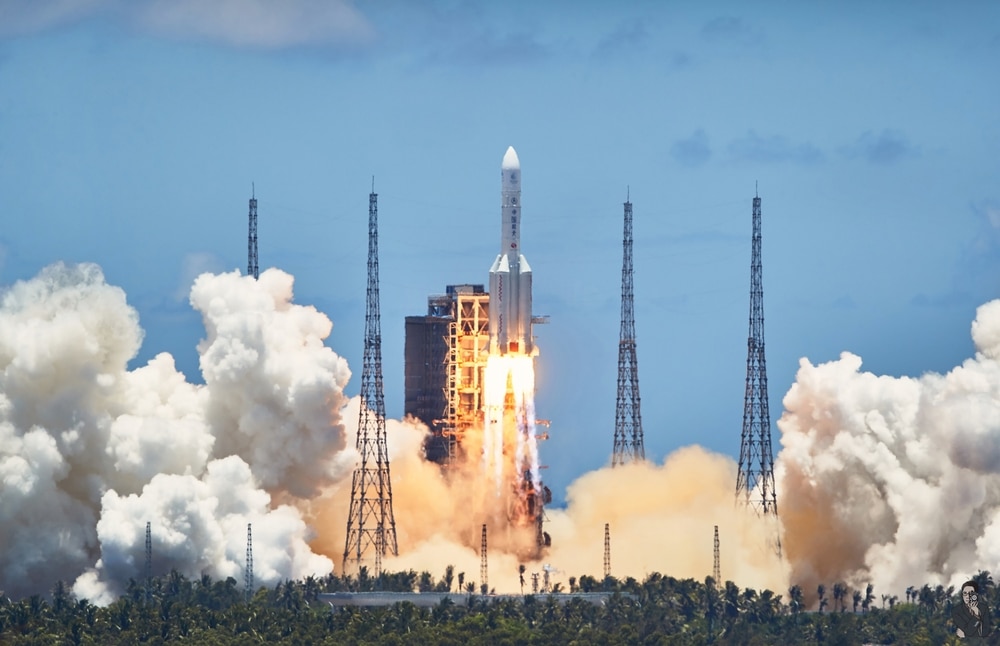
China’s state-owned rocket developer successfully recovered the first stage of an orbital launch vehicle for the first time Friday, making China the second country after the United States to achieve powered booster recovery from an orbital mission.
The Long March 10B carrier rocket lifted off at 12:15 p.m. local time (04:15 UTC) from the Hainan International Commercial Aerospace Launch Center in Wenchang, in southern China’s Hainan Province. Approximately six minutes after stage separation, the booster descended and was captured by the Linghang Zhe, a dedicated recovery vessel equipped with a tensioned cable-net system, in waters roughly 186 miles (300 kilometers) from the launch site, the China Aerospace Science and Technology Corporation (CASC) confirmed.
The China Aerospace Science and Technology Corporation confirmed the recovery 11 minutes after liftoff. Full mission success, including insertion of an unnamed satellite into its designated orbit, was confirmed more than 90 minutes after launch. The payload’s identity, purpose, and orbital parameters were not disclosed.
China has become the second country in the world with an orbital-class launcher system with first-stage booster recovery through controlled reentry and propelled landing.
After delivering its payload to low Earth orbit, The Long March 10B had its booster landing on a recovery… pic.twitter.com/JKO4jqKcze
— Visegrád 24 (@visegrad24) July 10, 2026
The Long March 10B is a two-stage, medium-lift vehicle measuring 207 feet (63 meters) in length, with a liftoff mass of approximately 1.68 million pounds (760,000 kilograms). Its first stage is powered by seven YF-100K liquid oxygen-kerosene engines producing a combined 890 metric tons of thrust. The second stage burns liquid oxygen and methane, marking what is believed to be the first flight of CASC’s YF-219 methalox engine. In reusable configuration, the rocket is capable of delivering 35,000 pounds (16 metric tons) to low Earth orbit, according to CASC.
Unlike SpaceX’s Falcon 9 and Blue Origin’s New Glenn, which use deployable landing legs to return boosters vertically to a pad or drone ship, the Long March 10B relies on mechanical hooks mounted on the vehicle that engage tensioned cables on the recovery platform. CASC described the method as the world’s first successful net-based recovery of an orbital-class carrier rocket.
A historic day in China’s space program!
China’s Long March-10B has successfully completed its maiden flight—and recovered its first stage via a sea-based net. This marks the country’s first-ever controlled rocket recovery. A major leap toward reusable launch capabilities.… pic.twitter.com/FWuQXLltaD
— Mao Ning 毛宁 (@SpoxCHN_MaoNing) July 10, 2026
The achievement follows two failed Chinese recovery attempts in recent years, including a landing-leg-equipped Long March 12A variant and a first recovery attempt by commercial firm LandSpace using its Zhuque-3 rocket. Friday’s mission marked the first time any Chinese vehicle completed the final capture phase of a booster return.
CASC said it intends to refly the recovered booster before the end of 2026. “Going forward, the Long March 10B carrier rocket development team will continue to optimize rocket performance and accelerate the iterative upgrade of reusable rocket technology,” the corporation said in a statement.
The mission also carries significance for China’s human spaceflight program. The Long March 10B’s first stage is common to the Long March 10A, a rocket designed to launch the new Mengzhou crewed spacecraft, a partially reusable successor to Shenzhou, to low Earth orbit. The full tri-core Long March 10 is intended to carry Chinese astronauts to the lunar surface before 2030, according to SpaceNews.
SpaceX first achieved orbital booster recovery in December 2015 with its Falcon 9. Blue Origin’s New Glenn followed in November 2025. SpaceX now launches Falcon 9 hardware approximately 150 times per year, routinely reflying boosters dozens of times, a cadence made possible by the economics of reuse.
Shares in Chinese aerospace firms rose sharply on news of Friday’s recovery, with China Spacesat and China Satellite Communications reaching their daily trading limits on domestic exchanges, according to Reuters.