Germany has agreed to purchase ground-launched Tomahawk cruise missiles from the United States, Chancellor Friedrich Merz announced Thursday, closing a long-range strike gap that left Berlin unable to threaten targets more than roughly 43 miles away with land-based systems.
Merz disclosed the agreement in a statement to the Bundestag, saying he secured the deal on the sidelines of the 36th NATO Summit in Ankara on Tuesday and Wednesday. German government sources told Reuters that defense ministers from both countries signed a letter of intent Tuesday, with Washington committing to grant formal export approval by August.
“We are closing a critical strategic gap in our defense, while simultaneously working to develop our own European systems and station them in Europe,” Merz said.
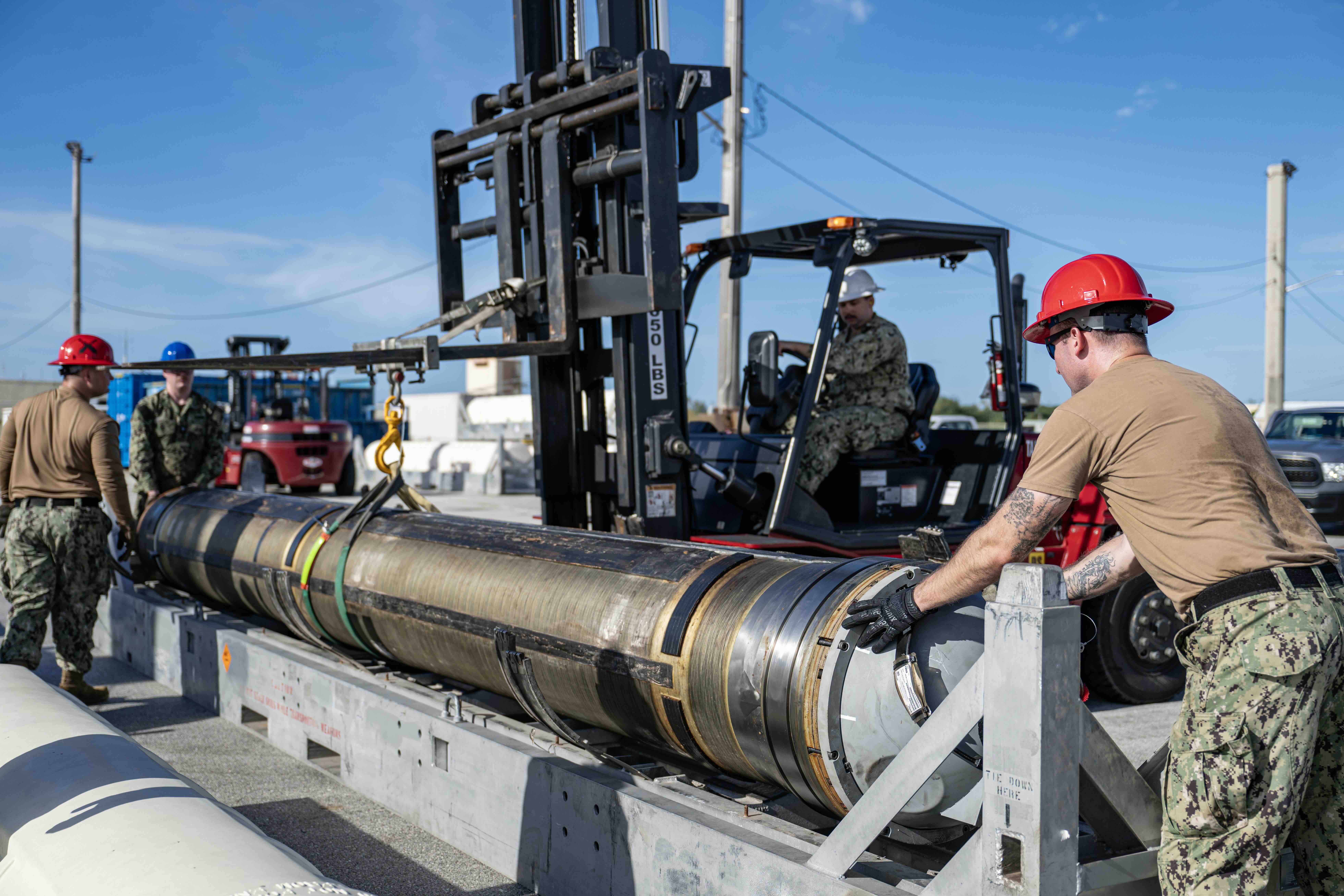
The number of missiles and ground-based Typhon launchers Germany plans to acquire remains classified. Earlier reports placed the potential order at up to 400 Tomahawk Block Vb missiles valued at more than $1 billion.
The Block Vb is the latest production variant of the Tomahawk and carries a joint multi-effects warhead suited to striking a wide range of land targets. All Block V missiles are equipped with a two-way datalink that allows operators to redirect or re-task the weapon during flight. The variant has a range exceeding 1,000 miles, depending on configuration.
Germany’s current longest-range land-based fires system is the M270 Multiple Launch Rocket System, which the German Army designates MARS II. Rockets for the system reach targets at approximately 43 miles. Berlin has not received U.S. Army Tactical Missile System (ATACMS) ballistic missiles, which can engage targets at up to 186 miles.
The purchase fills that gap while Germany pursues longer-term European alternatives. Berlin participates in the European Long-Range Strike Approach, an initiative also involving France, Italy, Poland, Sweden, and the United Kingdom, which targets a missile with a range of 620 to 1,240 miles for entry into service in the 2030s. Germany and the United Kingdom have separately announced plans to co-develop a precision strike weapon with a range exceeding 1,240 miles, though that program remains at an early stage.
The Tomahawk deal also marks a significant pivot from earlier U.S. plans. The Biden administration announced in 2024 that the Army’s 2nd Multi-Domain Task Force would begin episodic deployments to Germany in 2026, bringing Typhon launchers capable of firing both Tomahawk and SM-6 missiles. The Trump administration moved away from that plan in May, announcing a reduction of 5,000 U.S. troops in Germany and signaling the cancellation of the task force deployment.
Germany had previously tried to purchase Tomahawks directly and been turned down by Washington. The approved sale now gives Germany access to a system currently operated outside the United States only by Australia, Japan, the Netherlands, and the United Kingdom. All four of those countries use the naval-launched version; Germany would be the first export customer to deploy the ground-launched variant.
Russia’s expanding inventory of intermediate-range missiles has driven the urgency. Moscow deployed nuclear-capable Iskander ballistic missiles and MiG-31 aircraft armed with Kinzhal air-launched ballistic missiles to its Kaliningrad exclave in the Baltic. Russia also used the Oreshnik intermediate-range ballistic missile in combat for the first time in November 2024 during strikes on Ukraine, and has reportedly used its 9M729 ground-launched cruise missile operationally in that conflict.
The legal architecture that once prohibited such weapons on the continent collapsed in 2019, when the United States withdrew from the Intermediate-Range Nuclear Forces Treaty, citing Russian deployment of the 9M729. Russia formally suspended its own participation in 2023.
Germany made a domestic cruise missile, the Taurus, but its range of approximately 310 miles is roughly three to five times shorter than the Tomahawk’s, leaving Berlin reliant on Washington for weapons in this class until European programs mature.