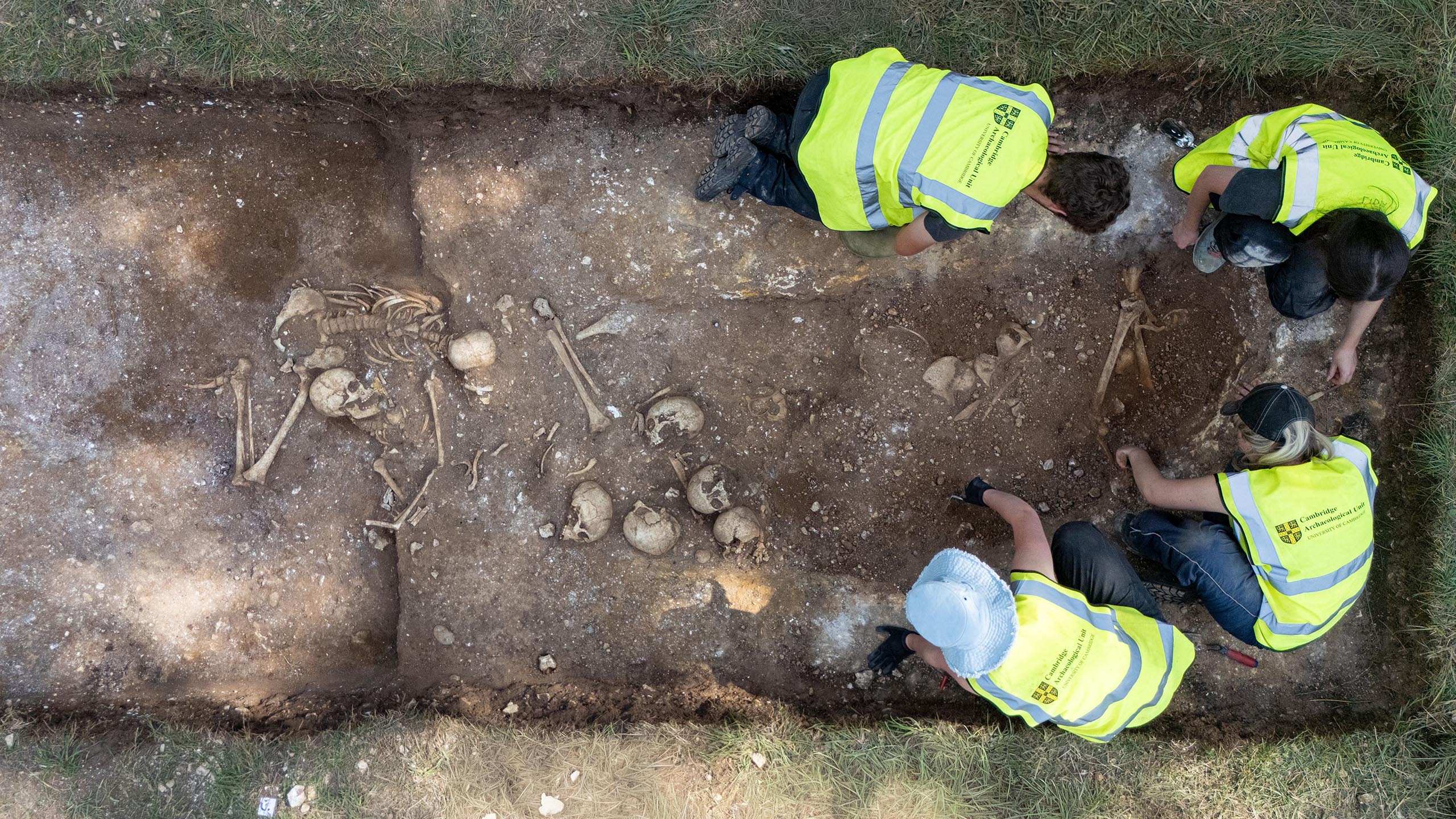
University students on a routine training excavation have uncovered what archaeologists believe may be a Viking-era execution pit containing at least 10 bodies, some decapitated and others bound at the wrists and ankles.
The discovery at Wandlebury Country Park, three miles outside Cambridge, includes a 13-by-3-foot pit holding a mix of complete skeletons and dismembered remains. Radiocarbon dating places the burial between 772 and 891 CE, a period when the region passed from Saxon to Viking control. Excavators also found skulls separated from their bodies and severed legs piled together.
Four complete skeletons were positioned in ways suggesting the individuals were restrained when buried. One body was thrown face down with arms and legs apparently tied together, while another shows clear evidence of decapitation.
Perhaps the most unusual discovery is the remains of a man between 17 and 24 years old who would have stood approximately 6 feet 5 inches tall, towering nearly a foot above the average height of 5 feet 6 inches for the period.
His skull contains a 3-centimeter oval hole from trepanation, an ancient surgical procedure in which bone is removed from a living patient’s head to relieve pressure. Dr. Trish Biers, curator of the Duckworth Collections at Cambridge, said the man’s exceptional height may indicate a pituitary condition, and the surgery could have been an attempt to alleviate resulting headaches.
The historical context offers two possible explanations. In the late 700s, Cambridge fell under the Saxon Kingdom of Mercia before the Viking Great Army pillaged the area around 874-875 CE and absorbed it into the Viking kingdom of East Anglia. If the bodies date from the 9th century, they may represent battle casualties. If from the 8th century, the pit more likely served as a site of judicial execution.
Archaeologists believe all 10 individuals were male and plan to examine teeth to determine diet and geographic origin, which should help establish whether the dead were Anglo-Saxons or Vikings. The discovery will be featured in an episode of the BBC’s “Digging for Britain.”