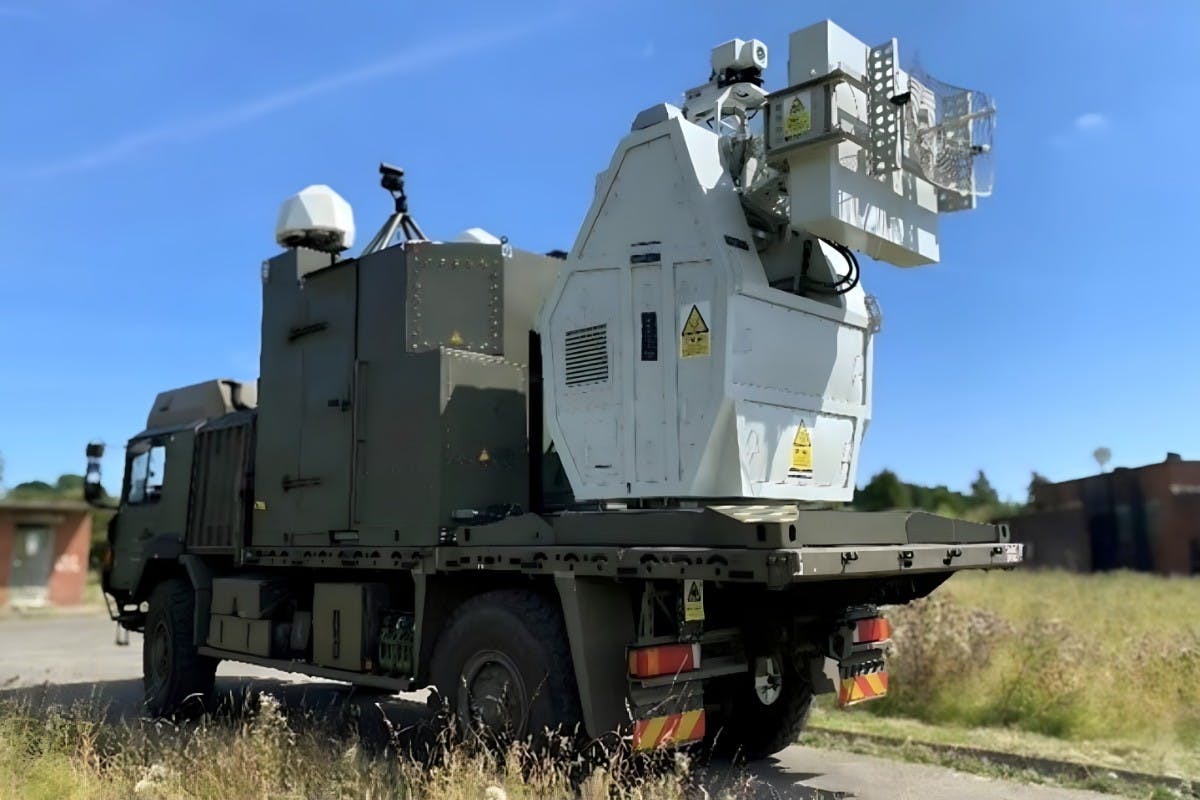
The British Army has successfully tested a next-generation radiofrequency directed energy weapon (RF DEW) capable of disabling entire swarms of drones using concentrated bursts of high-frequency radio waves, the Ministry of Defence (MoD) announced Thursday.
Developed by a U.K.-led consortium spearheaded by Thales UK, the weapon, nicknamed RapidDestroyer, was trialed at the Air Defence Range in Manorbier, southwest Wales. During the live-fire test, British troops reportedly neutralized over 100 drones, including two full swarms in a single engagement, marking the first operational use of such a weapon by British forces.
According to the MoD, RF DEW systems work by emitting targeted radio waves that disrupt or destroy the internal electronics of drones, causing them to crash. Unlike traditional jamming, which interferes with communications, RF DEW attacks the hardware directly—making it effective even against autonomous drones or those resistant to jamming.
“This significant experiment exemplifies the strength of British innovation – driven by our home-grown industry, technology firms and scientific talent,” said Minister for Defence Procurement and Industry, Maria Eagle MP.
The RapidDestroyer system was operated in the field by Sgt. Mayers of 106 Regiment Royal Artillery, the first British soldier to engage drones using radiofrequency energy. “RF DEW is an exciting concept,” Mayers said. “We found the demonstrator quick to learn and easy to use. With improvements on range and power… this would be a great asset to Layered Air Defence.”
In trials, RapidDestroyer demonstrated the ability to disable multiple targets almost instantly, with an effective range of up to 1 kilometer (0.62 miles). Each shot costs roughly 10 pence ($0.18), offering a dramatically cheaper alternative to traditional missile interceptors—particularly against massed drone attacks.
The U.K. government has invested over £40 million ($53 million) in RF DEW research, supporting more than 135 jobs, including 100 in Northern Ireland and 35 across the Chelmsford supply chain. The project operates under the Team Hersa initiative, a collaboration between Defence Equipment & Support and the Defence Science and Technology Laboratory (Dstl).
Nigel MacVean, Managing Director of Thales Integrated Airspace-protection Systems, noted the system’s broader utility: “Thales continues to be at the forefront of this pioneering technology. Such systems could help protect security-sensitive areas such as defense bases… and prevent disruption at airports.”