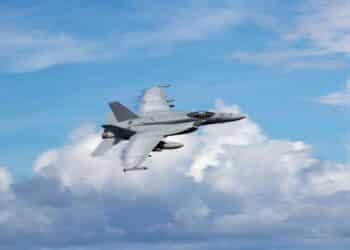
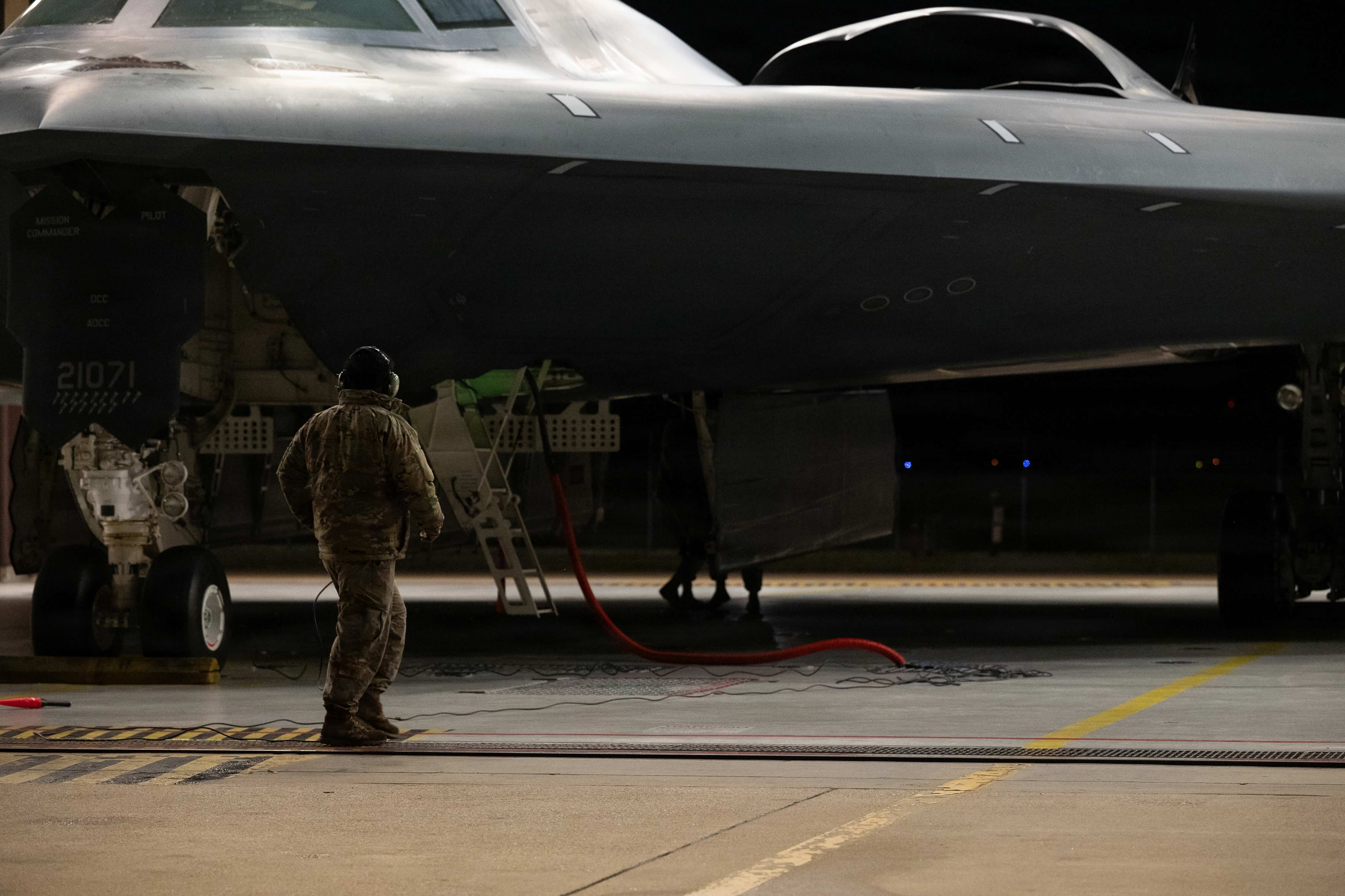
Photos released by U.S. Central Command (CENTCOM) on March 24 show two B-2A Spirit stealth bombers departing Whiteman Air Force Base, Missouri, for a strike mission over Iran on March 17, with rows of unidentified white rectangular patches affixed along the leading edges of both wings, top and bottom. The Air Force has offered no explanation for the patches.
B-2 stealth bombers takeoff to conduct a mission during Operation Epic Fury, delivering long-range fire to not only eliminate the threat from the Iranian regime today, but also eliminate their ability to rebuild in the future. pic.twitter.com/ebyUYNnOLo
— U.S. Central Command (@CENTCOM) March 13, 2026
The patches, white rectangles with black borders appearing to be tape-sealed, are visible in at least nine pairs on the port wing of Spirit of Louisiana and at least 11 on the starboard wing. The same patches appear on Spirit of Mississippi, identified by markings on both aircraft’s landing gear doors. The count and placement are not fully symmetrical between the two airframes.
Four explanations have circulated among defense analysts. The patches resemble fiducial test markings, reference points used to measure airframe parameters during flight trials, but their presence on two separate combat aircraft operating over Iran argues against that. Radar reflectors are a second possibility, though the B-2 does not typically use removable reflectors the way the F-22 Raptor or F-35 Lightning II do, and its stealth properties remain a core operational advantage.
The timing of the patches draws attention to ongoing B-2 modernization. Sierra Nevada Corporation announced in February that a B-2 had completed the first flight of the Adaptable Communications Suite (ACS) 4.0, a beyond-line-of-sight satellite communications upgrade developed with Northrop Grumman, just five days before Operation Epic Fury began on February 28.
A parallel effort, the Spirit Realm 1 (SR1) program, integrates new sensors, software, and weapons through an open mission systems architecture. The Air Force has not confirmed any connection between either upgrade and the patches. Repairs to the B-2’s radar-absorbent material (RAM) coating remain a fourth possibility, though identical placement across two separate airframes makes routine maintenance an unlikely explanation.
CENTCOM confirmed on March 6 that B-2s struck approximately 200 targets inside Iran during a 72-hour period.
Last night, U.S. B-2 stealth bombers, armed with 2,000 lb. bombs, struck Iran’s hardened ballistic missile facilities. No nation should ever doubt America’s resolve. pic.twitter.com/6JpG73lHYW
— U.S. Central Command (@CENTCOM) March 1, 2026
CENTCOM commander Adm. Brad Cooper said the operations focused on “areas surrounding Tehran.”
The bombers have flown round-trip from Whiteman throughout the campaign rather than forward-deploying, as B-1B Lancer and B-52H Stratofortress bombers have done at RAF Fairford in the United Kingdom.
The B-2 fleet previously struck Iranian nuclear sites at Fordo, Natanz, and Isfahan during Operation Midnight Hammer in June 2025.
“Today, it was a great honor to visit and congratulate the B-2 pilots, crews, and maintainers at Whiteman Air Force Base who executed Operation MIDNIGHT HAMMER. After today’s visit, I’m even more convinced of just how historic this mission was – from the years of analysis of the… pic.twitter.com/9744BAHWeY
— U.S. Central Command (@CENTCOM) June 26, 2025
The B-2A fleet comprises 19 airframes, with two typically in Programmed Depot Maintenance (PDM) at Plant 42 in Palmdale, California. The purpose of the patches has not been independently verified.