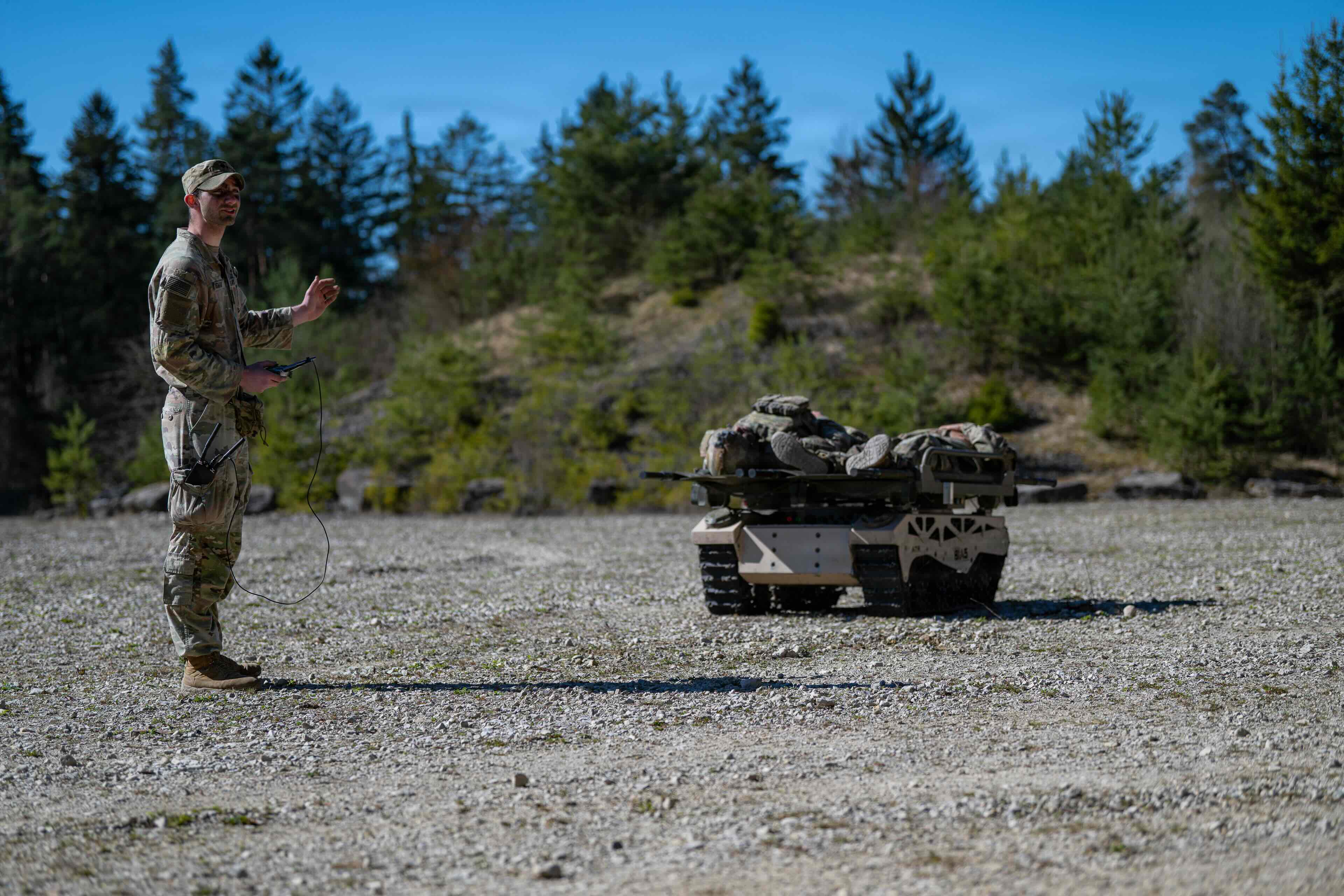
The U.S. Army’s recently activated autonomous systems command is soliciting industry for an unmanned ground vehicle capable of resupplying frontline troops and evacuating casualties in the contested space nearest enemy lines, according to a Commercial Solution Opening notice posted April 16.
The solicitation, issued by the Capability Program Executive Office for Mission Autonomy, a command activated in February 2026 at Fort Belvoir, Virginia, targets what the Army calls the “last tactical mile,” the final stretch of terrain approaching the forward line of troops where exposure to enemy drones, artillery, and snipers is greatest. Industry responses were due April 28.
CPE Mission Autonomy Activated!
Last month, the Army officially launched CPE Mission Autonomy at Fort Belvoir, Va., led by MG Clair Gill. This new organization is set to revolutionize Army operations with cutting-edge autonomous systems.#ArmyModernization #CPEMissionAutonomy— PAE Maneuver Air (@PAE_ManeuverAir) March 23, 2026
“The modern battlefield is characterized by persistent enemy surveillance and rapid application of lethal effects at and behind the forward line of troops, making any movement to and from the FLOT highly vulnerable,” the Army stated in the notice. “This environment challenges commanders’ ability to resupply units and evacuate casualties.”
The required platform must carry enough cargo to sustain a dismounted rifle platoon and a company headquarters while traversing on- and off-road terrain, including GPS-denied environments. For casualty evacuation, the Army requires quick reconfiguration with minimal changes and the ability to transport at least two wounded personnel to a collection point without worsening their injuries.
“The UGV must be capable of teleoperation, autonomous navigation, and beyond-line-of-sight communications,” the service stated. It must also minimize detectable signatures and emissions during final approaches to supported units.
The timing of the solicitation is significant. The CPE Mission Autonomy office was stood up weeks before the notice was posted, making this one of its first major acquisition actions. Col. Ken Bernier, the Army’s project manager for autonomous robotic capabilities, said in February the service intends to pursue “problem statements” rather than rigid requirements to let industry lead on solutions.
The notice does not specify vehicle weight or overall payload capacity. It does, however, point toward hardware already in the Army’s pipeline. The Small Multipurpose Equipment Transport, or S-MET, program is developing cargo-carrying UGVs alongside this effort.
In early April, soldiers assigned to the 101st Airborne Division used the HDT Expeditionary Systems Hunter Wolf, an all-terrain UGV capable of carrying 2,800 pounds of supplies, during training at the Joint Readiness Training Center at Fort Johnson, Louisiana. A separate version of the platform fielded at that exercise carried a remotely operated .50-caliber machine gun.
The urgency behind the solicitation traces directly to Ukraine, where Ukrainian Defense Minister Mykhailo Fedorov stated in April that unmanned ground robots completed more than 9,000 frontline missions in March alone, a record. Ukraine contracted 25,000 UGVs for the first half of 2026, more than double its total for all of 2025.
A lieutenant in the Ukrainian 3rd Army Corps told The Guardian that robotic systems now handle approximately 90% of the army’s frontline logistics under pervasive Russian drone coverage.
“UGVs are performing critical logistics and evacuation tasks on the battlefield,” Fedorov wrote on April 18. “In March alone” the systems set a record for monthly missions, he stated.
Industry responses to the Army’s solicitation closed April 28. Whether a contract award follows under the Commercial Solution Opening pathway or feeds into the broader S-MET Increment II prototyping effort, which American Rheinmetall Vehicles and HDT Expeditionary Systems are competing to win this spring, will determine how quickly a dual-role UGV reaches maneuver units.