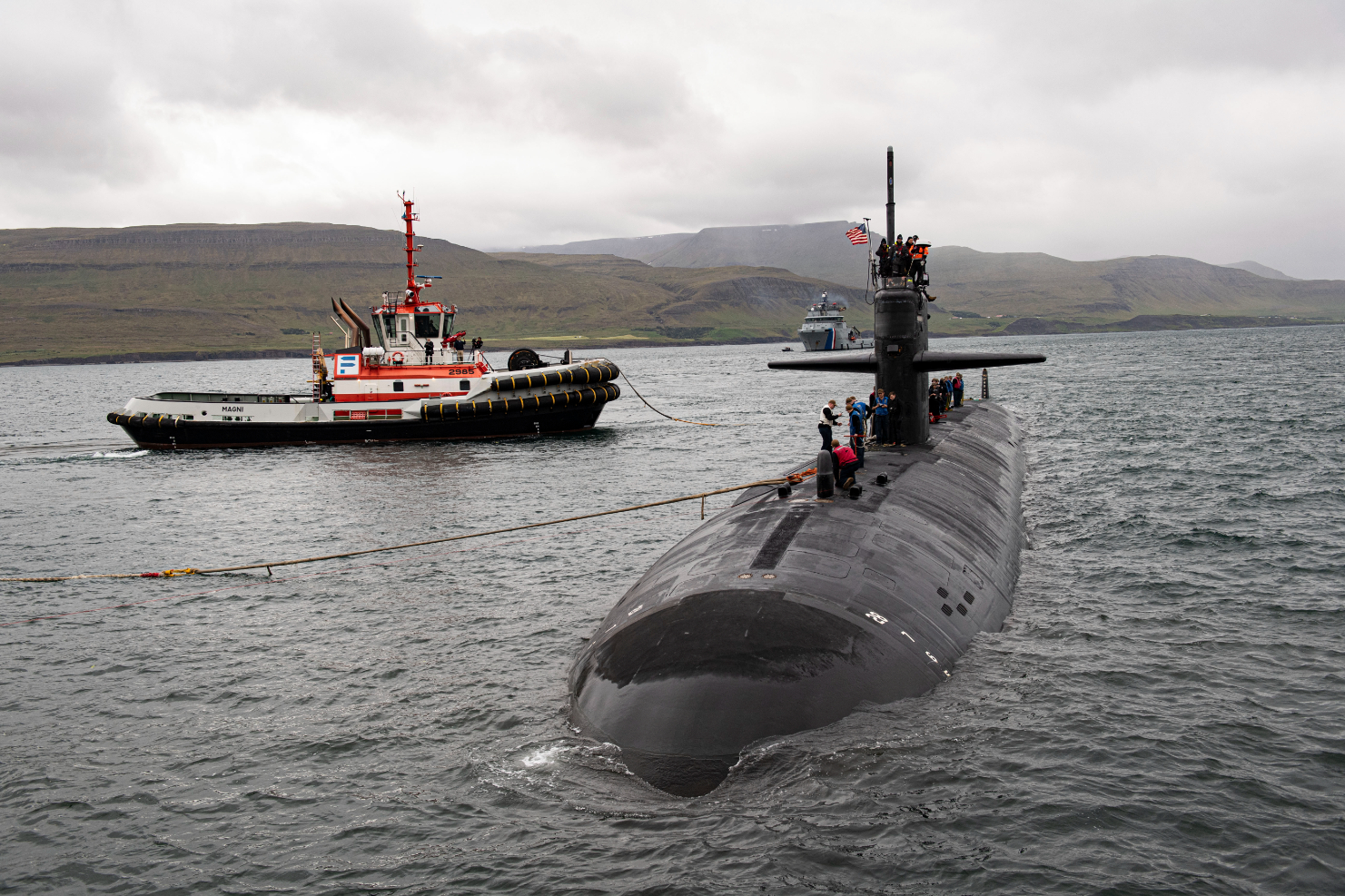
U.S. Navy nuclear-powered submarine USS Newport News arrived at Grundartangi pier in Hvalfjörður, near Reykjavik, on Wednesday, marking the first-ever port visit by a nuclear-powered submarine to Iceland, according to the U.S. Navy.
According to a Navy release, the port call follows Iceland’s 2023 policy change allowing nuclear-powered submarines to enter its territorial waters.
“This visit underscores our commitment to collective defense and Arctic security,” said Adm. Stuart B. Munsch, commander of U.S. Naval Forces Europe-Africa. “Our submarine forces are vital to deterring threats in a complex world.”
“It is an incredible honor for our submarine and crew to make history today with our cherished Ally, Iceland,” said Cmdr. Eric McCay, commanding officer of USS Newport News.
🇺🇸🤝🇮🇸
The Los Angeles-class fast-attack submarine USS Newport News (SSN 750) conducted a port visit in Iceland, marking the first time a nuclear-powered submarine pulls into port on Iceland’s shores, July 9, 2025. ⚓️ @usnavy #Navy250 https://t.co/IoMVURc9VG pic.twitter.com/838hEt5dsf
— U.S. Naval Forces Europe-Africa/U.S. 6th Fleet (@USNavyEurope) July 9, 2025
Erin Sawyer, chargé d’affaires at the U.S. Embassy in Iceland, said the visit reflects “deep coordination with our NATO ally Iceland” and a shared goal of maintaining low tensions in the Arctic, despite Russia’s military buildup.
Submarines like the USS Newport News are fast-attack vessels built to support special operations, gather intelligence, and monitor threats at sea. They are also equipped to launch Tomahawk cruise missiles for long-range precision strikes.
Iceland news outlet Vísir.is reported that while this marks the first port call to Iceland, U.S. submarines have entered the country’s territorial waters six times since 2023, when Iceland’s Ministry for Foreign Affairs (MFA) announced that such vessels would be allowed to make brief offshore stops to rotate or replace crew members.
“The frequency of visits will depend on the need at each time,” the outlet quoted the MFA as saying, adding that the procedures were developed in close coordination with the United States and are based on similar arrangements in neighboring countries.
Iceland, a founding NATO member with no standing military of its own, hosted U.S. forces during the Cold War and continues to serve as a key strategic outpost in the GIUK Gap—the naval corridor between Greenland, Iceland, and the United Kingdom.