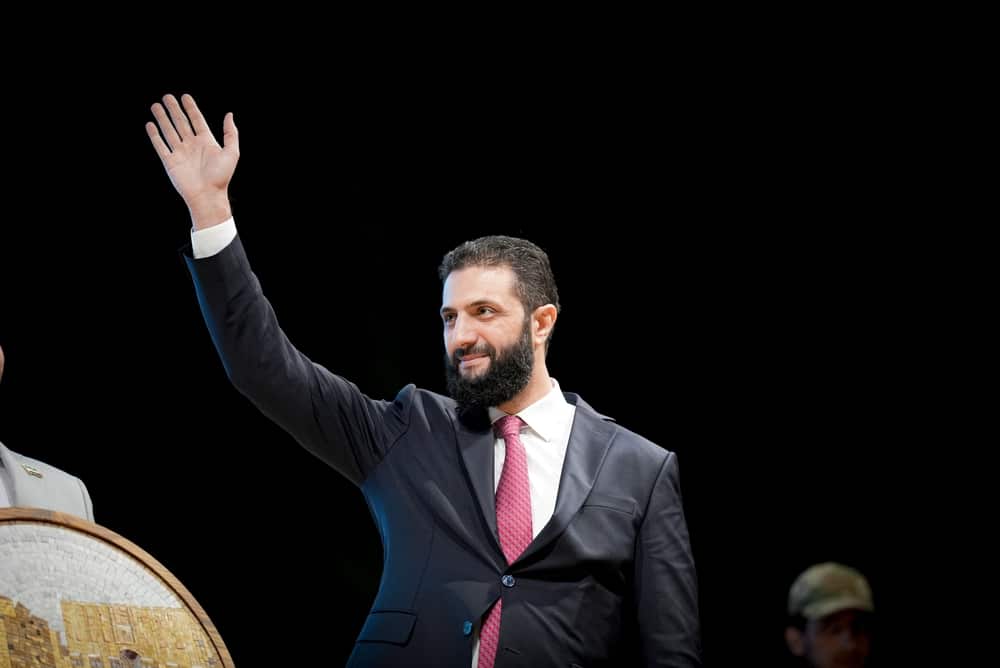
The top U.S. general overseeing American forces in the Middle East met with Syrian President Ahmed al-Sharaa at the presidential palace in Damascus on Friday to discuss counterterrorism efforts and regional stability, U.S. Central Command announced.
Admiral Brad Cooper, commander of U.S. Central Command, was joined by U.S. Ambassador and Special Envoy for Syria Thomas Barrack in the meeting with al-Sharaa. The rare high-level diplomatic encounter focused primarily on efforts to eliminate the Islamic State threat in Syria.
What an honor to meet with Admiral Cooper and President al-Sharaa in Damascus today. Grateful for the opportunity to discuss continued collaboration with President al-Sharaa to counter ISIS and work toward a stable, peaceful Syria. pic.twitter.com/23WixYfJU6
— Ambassador Tom Barrack (@USAMBTurkiye) September 12, 2025
“During the meeting, Cooper and Barrack thanked President al-Sharaa for his support to counter ISIS in Syria,” Central Command said in a statement. The command added that “eliminating the ISIS threat in Syria will reduce the risk of an ISIS attack on the U.S. homeland while working towards President Trump’s vision of a prosperous Middle East and a stable Syria at peace with itself and its neighbors.”
The U.S. officials also praised Syria for supporting the recovery of American citizens inside the country. Central Command said the discussions included negotiations for integrating various Syrian armed groups into the new Syrian government’s military structure.
U.S., Syrian Leaders Meet in Damascus
On Sept. 12, U.S. Central Command (CENTCOM) Commander Adm. Brad Cooper and U.S. Ambassador and Special Envoy for Syria Thomas Barrack met with Syrian President Ahmed al-Sharaa at the Presidential Palace in Damascus, Syria.
During the… pic.twitter.com/4iToe4imOE
— U.S. Central Command (@CENTCOM) September 12, 2025
The integration talks come as tensions escalate between Damascus and the Kurdish-led Syrian Democratic Forces, despite a March agreement signed between al-Sharaa and SDF commander Mazloum Abdi. That agreement stipulated the SDF should integrate into Syrian government military and civil structures, but recent clashes and political disputes suggest the deal is failing.
On Wednesday, two civilians were killed and three wounded in fighting between the sides in eastern Aleppo province, with each faction blaming the other for initiating hostilities. Syria’s Defense Ministry accused the SDF of launching “an irresponsible and sudden campaign of heavy shelling” targeting civilian villages, according to the state-run Syrian Arab News Agency.
The SDF denied the accusations and claimed government-aligned fighters initiated the violence. “Our forces decisively repelled the infiltration and artillery attacks launched by these groups,” the SDF said in a statement, according to Kurdistan24.
The SDF claimed Damascus-backed forces attempted to infiltrate the Deir Hafar area and that “the full responsibility for escalation lay with the party that initiated violations.”
The clashes highlight deeper political divisions over Syria’s future structure. The SDF continues demanding full political decentralization for Kurdish-majority regions, while Damascus has offered only limited administrative autonomy, according to The New Arab.