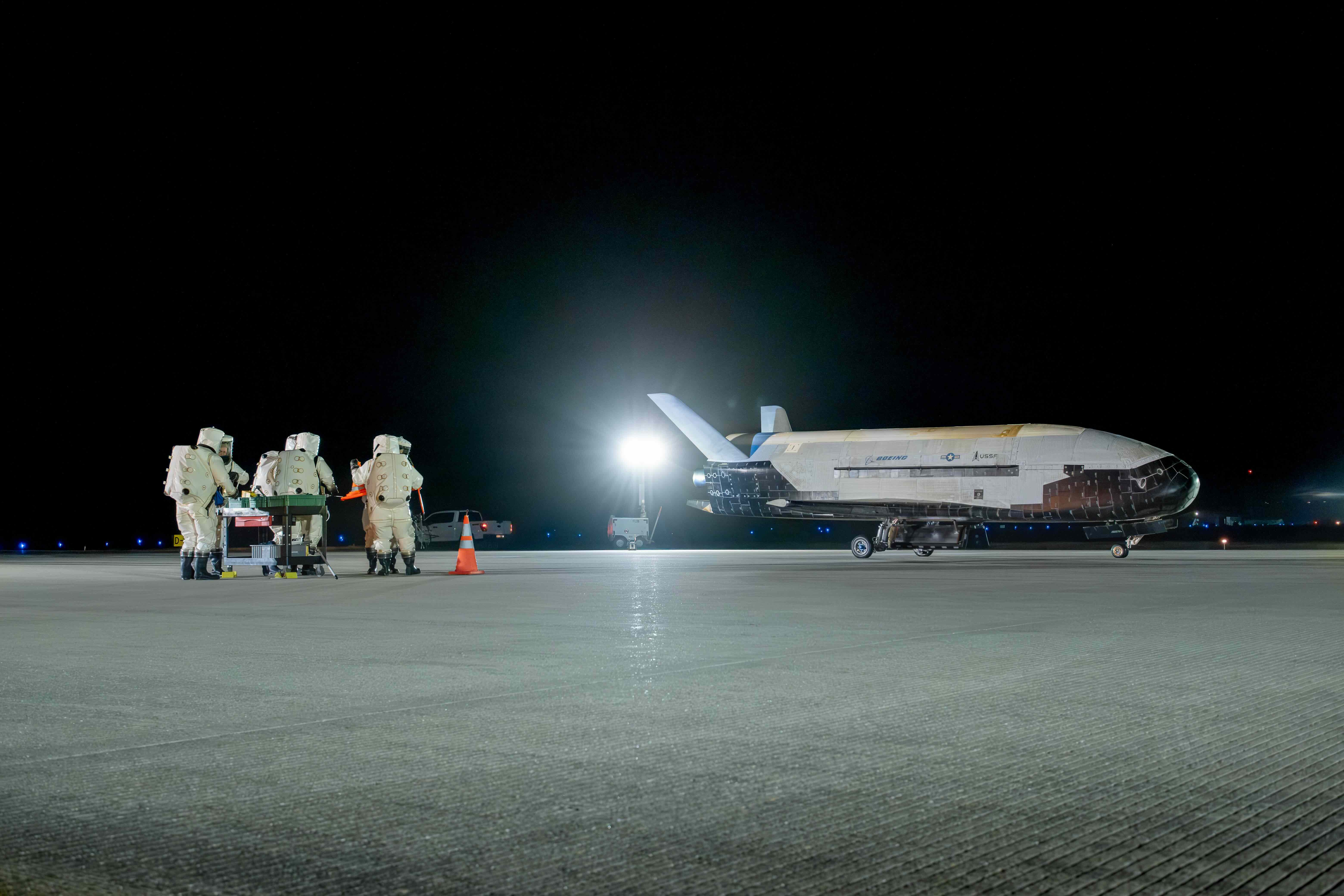
The U.S. Space Force (USSF) and Air Force Rapid Capabilities Office will launch the X-37B Orbital Test Vehicle’s eighth mission (OTV-8) on Aug. 21 from Kennedy Space Center.
In a statement, the USSF said the X-37B Mission 8 will launch aboard a SpaceX Falcon 9 rocket, designated USSF-36.
This flight will carry two key experiments: a laser communications system and a quantum inertial sensor.
According to the USSF, the laser communications experiment aims to enhance the “resilience, efficiency, and security of U.S. space-based communications architectures” by demonstrating laser links through proliferated commercial satellite networks in Low Earth Orbit.
The quantum inertial sensor experiment will demonstrate the most advanced sensor of its kind ever flown in space, the USSF added.
“This demonstration will inform accurate unaided navigation in space by detecting rotation and acceleration of atoms without reliance on satellite networks like traditional GPS,” said USSF. “This technology is useful for navigation in GPS-denied environments and consequently will enhance the navigational resilience of U.S. spacecraft in the face of current and emerging threats.”
The USSF notes that quantum inertial sensors hold promise for advancing the technological frontiers of long-distance space travel and exploration.
The X-37B, built by Boeing, is a reusable, autonomous spacecraft designed for long-duration orbital testing. Its previous flight ended on March 7 after spending 434 days in orbit.
Most notably, the mission marked the program’s first public image release from space.
While the exact details of the mission remain classified, the U.S. Space Force said in a news release that the X-37B “accomplished a range of test and experimentation objectives intended to demonstrate the X-37B’s robust maneuver capability while helping characterize the space domain through the testing of space domain awareness technology experiments” during its time in orbit.