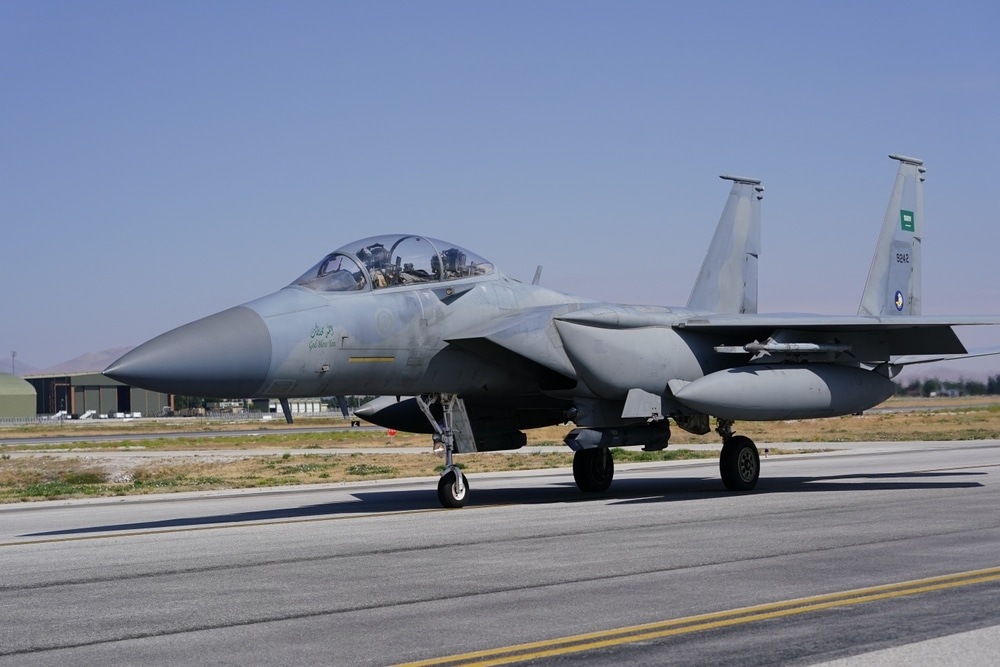
Saudi warplanes struck military positions held by UAE-backed separatist forces in Yemen’s Hadramout Governorate on Friday, marking another escalation of tensions between the two Gulf allies over control of the country’s oil-rich eastern provinces.
The Royal Saudi Air Force conducted at least seven airstrikes on the 37th Brigade military camp in al-Khasha, according to Mohammed Abdul Malik, head of the Southern Transitional Council in Wadi Hadramout.
Additional strikes hit the First Military Region headquarters in Sayun and the city’s airport, sources told AFP.
A senior STC official said the strikes caused casualties, though precise numbers were not disclosed. Al Jazeera reported that one STC member was killed and 15 wounded in clashes with Saudi-backed government forces in Sayun, located approximately 220 miles north of the coastal city of Mukalla.
The Royal Saudi Air Force 🇸🇦 carried out airstrikes this morning on the 37th Brigade camp in al-Khasha, Yemen’s Hadramout, which is held by UAE-backed 🇦🇪 STC forces. The strikes come ahead of a major offensive by the Saudi-backed National Shield Forces aimed at retaking the area. pic.twitter.com/vdq5UhjEI6
— Rich Tedd 🛰 ✈️ (@AfriMEOSINT) January 2, 2026
Hours after the strikes, the United Arab Emirates confirmed its last troops had departed Yemen.
“The UAE concluded the presence of its counterterrorism forces,” an unnamed government official told AFP.
The withdrawal came after Yemen’s internationally recognized government, backed by Saudi Arabia, demanded the UAE pull its forces within 24 hours on Tuesday. That ultimatum followed Saudi-led coalition strikes on the port of Mukalla, where officials accused the UAE of delivering ships loaded with armored vehicles, weapons and ammunition to the STC.
The Saudi-led Coalition to Support Legitimacy in Yemen has announced that it carried out “limited” airstrikes in the last few hours on the Port of Mukalla in Southern Yemen, targeting military equipment and vehicles for the Southern Transitional Council (STC) that has arrived via… pic.twitter.com/34wsv0PG0e
— OSINTdefender (@sentdefender) December 30, 2025
The confrontation stems from the STC’s seizure of Hadramout and al-Mahra governorates in early December, pushing out forces affiliated with Saudi-backed National Shield Forces. The oil-rich region borders Saudi Arabia, and Riyadh views the separatist expansion as a direct threat to its security interests.
Operation ‘Taking Over the Camps’
Hadramout Governor Salem al-Khanbashi, appointed Friday by Yemeni Presidential Leadership Council Chair Rashad al-Alimi to command Homeland Shield Forces, announced a military operation named “Taking Over the Camps” to regain control of key military sites from STC forces.
Al-Khanbashi said his forces took control of the al-Khasha military base, the largest army base in the region, and were moving toward Sayun.
STC deputy Ahmed bin Breik said Saudi-backed forces advanced toward the camps, but separatists refused to withdraw, leading to the airstrikes.
The Royal Saudi Air Force 🇸🇦 airstrike is reported to have targeted columns of armoured vehicles belonging to the UAE-backed 🇦🇪 STC forces at al-Khasha camp in Hadramout 🇾🇪. pic.twitter.com/1rxCR3nk6S
— Rich Tedd 🛰 ✈️ (@AfriMEOSINT) January 2, 2026
Mohamed al-Nakib, spokesperson for the STC-backed Southern Shield Forces, accused Saudi Arabia of using “Muslim Brotherhood and al-Qaeda militias” in what he called a “large-scale attack” that separatists repelled.
He likened the situation to Yemen’s 1994 civil war, “except that this time it is under the cover of Saudi aviation operations.”
Saudi Ambassador to Yemen Mohammed al-Jaber said the kingdom had spent weeks trying to convince the STC to leave Hadramout and al-Mahra, but faced “continued intransigence and rejection.”
Elisabeth Kendall, a Yemen expert at Girton College, Cambridge, told Al Jazeera the current Saudi-UAE confrontation differs from 2019 tensions due to shifting regional dynamics.
“We’ve got the UAE supporting the Rapid Support Forces in Sudan and that could potentially give them influence over an 800km coastline of Sudan on the Red Sea,” Kendall said. “We also have the UAE in control of Perim Island at the mouth of the Red Sea and at the other end of the Gulf of Aden and Socotra.”
She noted concerns about the UAE “dominating influentially a state along the 1,500km Yemeni coastline, especially at a time when the UAE is allied with Israel.”
Yemen’s History of Civil War
Yemen has been engulfed in civil war for more than a decade, with Iran-backed Houthi rebels controlling much of the north while a Saudi-UAE coalition has supported the internationally recognized government in the south.
However, the UAE also backs the STC, which seeks to restore South Yemen as an independent state, as it existed from 1967 to 1990.
Saudi Arabia views southern independence as a threat to long-term stability and its own economic security plans.
Yemeni Presidential Leadership Council Chair al-Alimi said the STC’s recent actions have threatened the security of both Yemen and the broader region.
Faraj al-Bahsani, Vice President of the Presidential Leadership Council, warned against turning weapons inward, saying any conflict within areas liberated from the Houthis “leads to further chaos” and “serves Yemen’s enemies, foremost among them the Houthi militia.”