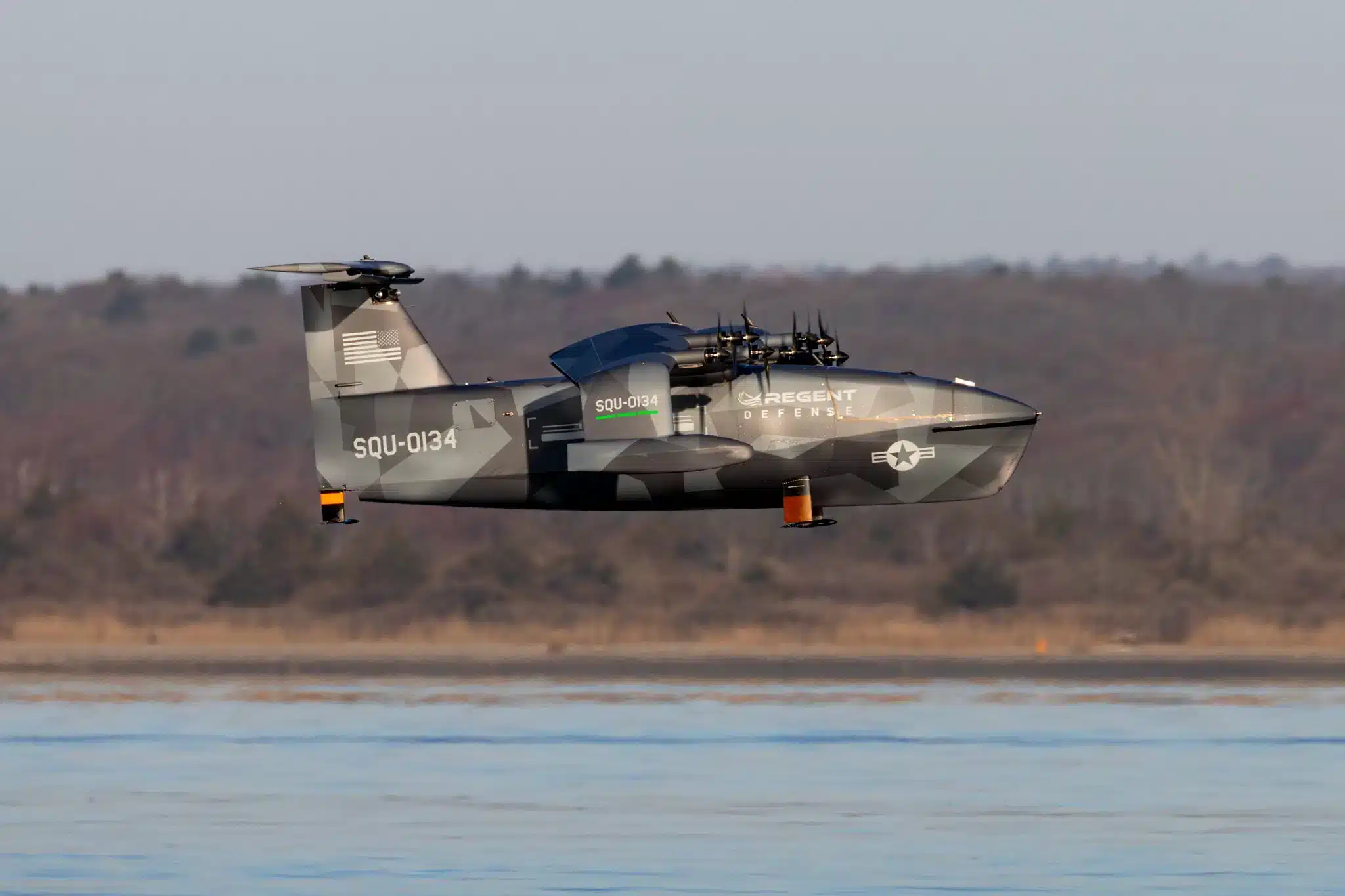
REGENT completed the first U.S. ground-effect flight of its autonomous Squire Seaglider on April 13 in Narragansett Bay, Rhode Island, in what the company announced as the first flight of a defense-specific wing-in-ground effect (WIG) craft in the United States.
🇺🇸Major milestone: We’ve successfully demonstrated flight with Squire, our autonomous Seaglider drone developed to support critical defense missions! pic.twitter.com/gTmeqMrs2J
— REGENT (@regentcraft) April 13, 2026
The milestone arrives roughly nine months after the Defense Advanced Research Projects Agency (DARPA) shut down the $98 million Liberty Lifter X-plane program, a three-year effort to build a C-17-class WIG transport that DARPA director Stephen Winchell said proved “harder than we thought.”
Following the closure of DARPA’s Liberty Lifter program, the Marine Corps Warfighting Lab (MCWL) is advancing domestic WIG research through a $10 million second-phase contract with REGENT, which follows a completed $4.75 million feasibility agreement. This shift highlights a continued, phased investment in seaglider technology for defense operations.
Sea trials continue for our autonomous @regentcraft Defense Seaglider drone, Squire. With each test, the team continues to validate the tech, expand the envelope, and advance our defense capabilities.
See how Squire is helping shape the next generation of maritime defense:… pic.twitter.com/DHBi69Ced7
— REGENT (@regentcraft) April 6, 2026
The Squire carries an 18-foot wingspan and eight electric engines, moving autonomously through three phases: hull floating, hydrofoiling, then WIG flight roughly one wingspan above the surface.
That low altitude traps a compressed-air cushion beneath the wings, cutting drag and enabling speeds up to 70 knots, a planned range exceeding 100 nautical miles, and a 50-pound payload, while staying below line-of-sight radar coverage.
“This successful flight milestone is a major success for our defense program and a strong signal of what Seaglider technology can deliver for the warfighter,” REGENT co-founder and CEO Billy Thalheimer said in a statement. “There are no products in the market today that combine the speed and wave tolerance of Squire at such a compelling price point.”
MCWL project manager Matthew Koch told The War Zone the Marines are watching the program closely, with REGENT scheduled to demonstrate Squire at Silent Swarm 26 in July and conduct a full-size flight test in early August.
“If the technology proves out in Silent Swarm this July and full-size flight in early August, I will have a statement on how the Marines intend to use it in the Pacific,” Koch said.