
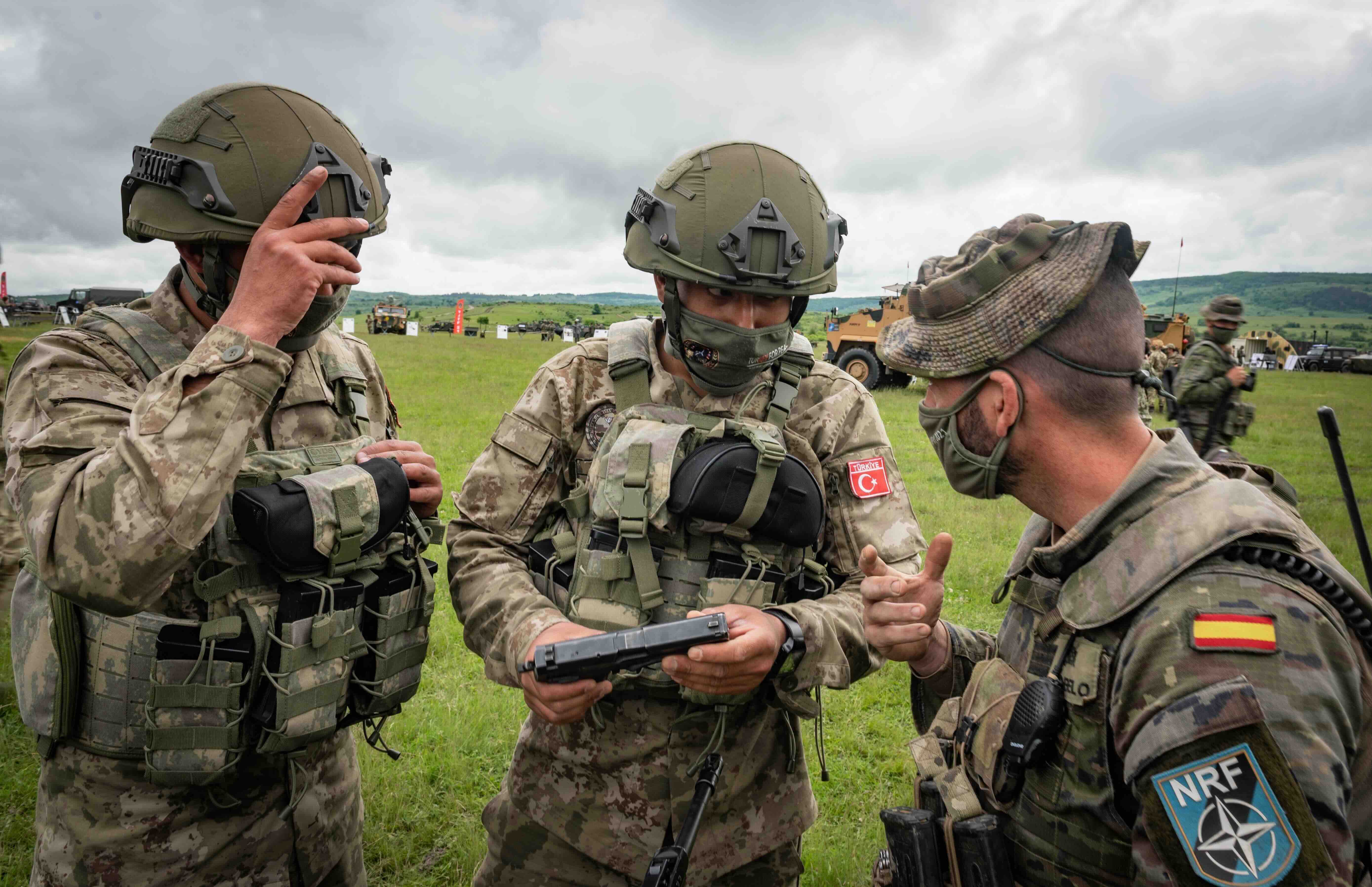
An internal Pentagon email has outlined options to punish NATO allies the United States believes failed to support operations in the war with Iran, including suspending Spain from the alliance and reviewing Washington’s longstanding backing of Britain’s claim to the Falkland Islands, a U.S. official told Reuters on Thursday.
The email, which circulated within the Defense Department, expressed frustration over allies’ perceived refusal to grant Access, Basing, and Overflight (ABO) rights for the Iran conflict, describing such access as “the absolute baseline for NATO,” according to the official, who spoke on condition of anonymity. The proposals were designed to decrease European allies’ “sense of entitlement,” the official said.
Spain drew particular attention in the memo after Defense Minister Margarita Robles announced on March 30 that Madrid would not authorize U.S. military aircraft involved in the Iran war to use its airspace or its bases at Morón and Rota.
Foreign Affairs Minister José Manuel Albares said the decision was intended to avoid doing “anything that could encourage an escalation in this war.”
The options outlined in the email obtained by Reuters also included suspending “difficult” member states from key or prestigious positions within NATO, according to reports citing the document.
NATO’s founding Washington Treaty contains no mechanism to suspend or expel a member state, and the alliance operates by consensus among all 32 member nations. Several allied diplomats told Reuters the proposals were “not serious.”
Spanish Prime Minister Pedro Sánchez, speaking at an informal European Union summit in Nicosia, Cyprus, on Friday, dismissed the email. “We don’t base our decisions on emails; we base them on official documents and government positions,” Sánchez said. He described Spain as a “loyal partner” that meets its obligations “within the framework of international law.”
The threat to re-examine U.S. support for British sovereignty over the Falkland Islands carries particular weight given the diplomatic momentum building around Argentina’s claim. Argentine President Javier Milei, among the most vocal backers of the U.S.-Israeli campaign in Iran, reaffirmed Buenos Aires’ sovereignty claim over the islands on April 2 and warned oil companies, including Rockhopper Exploration and Navitas Petroleum, of a diplomatic response to British-licensed exploration in the North Falklands Basin.
On April 7, Chilean President José Antonio Kast formalized his country’s support for Argentina’s claim in a joint statement issued after a state visit to Buenos Aires, calling on the United Kingdom to resume negotiations toward “a peaceful and definitive solution.”
Bolivia offered similar backing in early April, drawing a public rebuke from British Ambassador Richard Porter, who said: “The Falkland Islands are British. Their sovereignty is not in question.”
The leak arrives as the Iran conflict, which the United States designated Operation Epic Fury and launched jointly with Israel on February 28, has strained NATO cohesion to a degree not seen since the 2003 Iraq war.
President Donald Trump has criticized alliance members for failing to deploy naval assets to help reopen the Strait of Hormuz, which Iran closed following the opening of the air campaign. Trump has also said he is considering withdrawing the United States from the alliance.
At the Nicosia summit, EU leaders asked officials to prepare a blueprint for activating Article 42.7 of the EU Treaty, the bloc’s mutual assistance clause, amid what European Council President António Costa described as uncertainty over U.S. commitment to NATO’s Article 5 collective defense guarantee.