
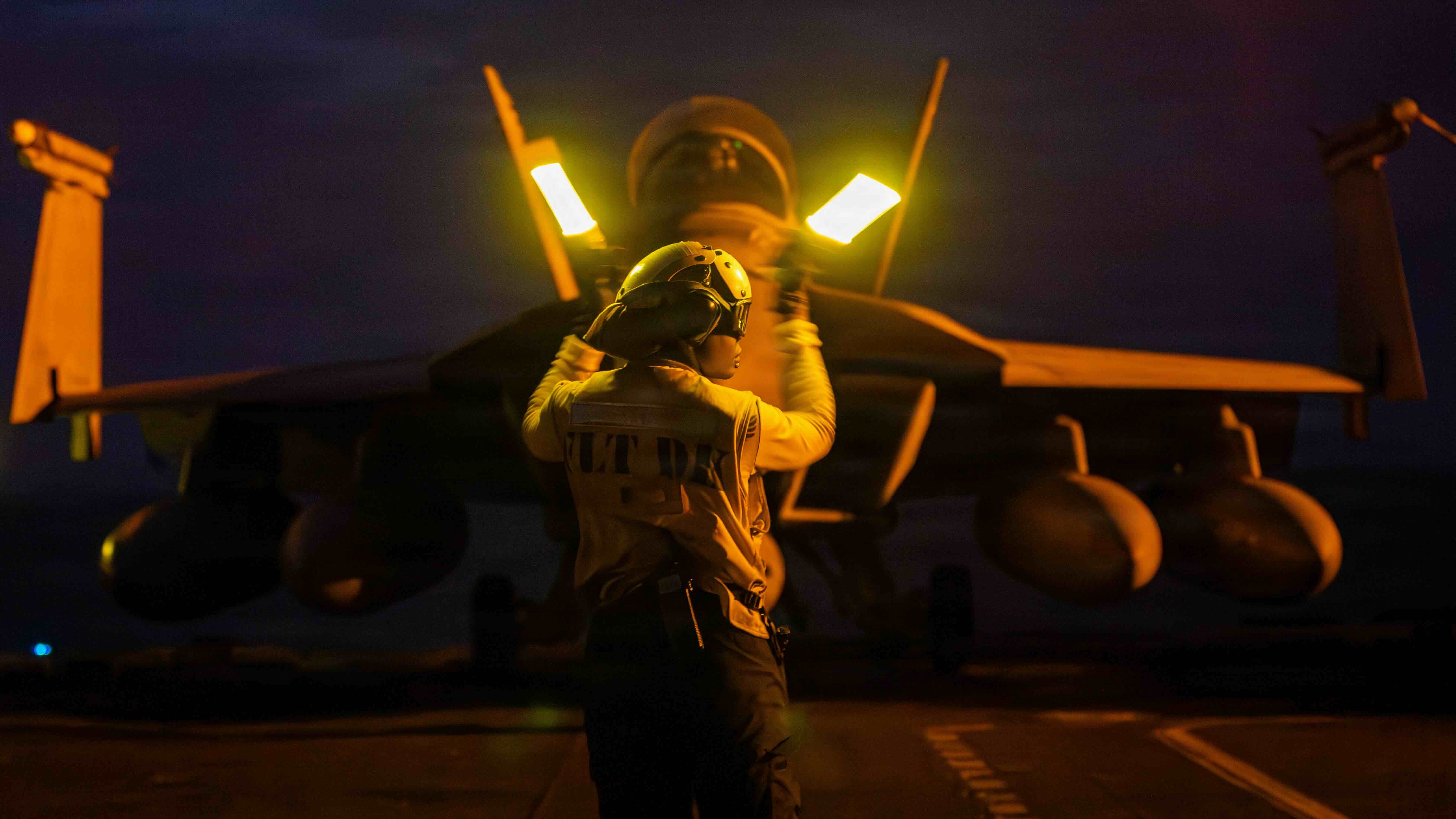
The U.S. Navy will select its next-generation carrier fighter, expected to feature extended range, enhanced stealth, and AI-enabled mission systems, in August, Chief of Naval Operations Adm. Daryl Caudle said.
The service will choose between Boeing and Northrop Grumman for the F/A-XX contract, which is set to replace the F/A-18E/F Super Hornet and EA-18G Growler. Lockheed Martin was previously removed from the competition after submitting a non-compliant bid.
“The need for F/A-XX is unquestionable. Peer competitors and even lesser adversaries are improving their anti-air capabilities,” Caudle told reporters.
Caudle said the Navy is double-checking contractor readiness before making a final decision on the F/A-XX program.
“One of the contractors who would make this plane for us is in a place where they really can’t deliver in the timeframe we need it. So there was a ‘check twice, cut once’ kind of mentality here on this decision,” Caudle said.
The F/A-XX program has faced repeated delays and debate within the Pentagon over cost, timing, and whether it should proceed alongside the Air Force’s F-47 fighter. Despite those concerns, Congress has continued to fund development, adding hundreds of millions of dollars above the Navy’s requests in recent budget cycles.
The Pentagon’s fiscal 2027 request includes $140 million for the program.
A final downselect in August would move the program into the engineering and manufacturing development phase, setting the stage for production of the Navy’s future carrier fighter.
Meanwhile, Northrop Grumman has recently added attention to the competition by releasing a new concept video showing a notional F/A-XX design.
We’re bringing tomorrow’s horizon into focus, faster, stronger and ready when the warfighter needs it.#SAS2026 pic.twitter.com/r0uORyR5kM
— Northrop Grumman (@northropgrumman) April 20, 2026
The 15-second clip, posted on social media, appears to show the same tailless, folding-wing aircraft concept first revealed in 2025.
The rendering shows a stealth-focused jet optimized for carrier operations, including low-observable air inlets positioned on top of the fuselage behind the cockpit. The number of engines and internal configuration are not disclosed.
A Boeing win would follow its recent selection for the Air Force’s F-47 program. For Northrop Grumman, a contract would mark a return to prime fighter production since the F-14 Tomcat, the iconic U.S. Navy jet made famous by the 1986 film Top Gun.