
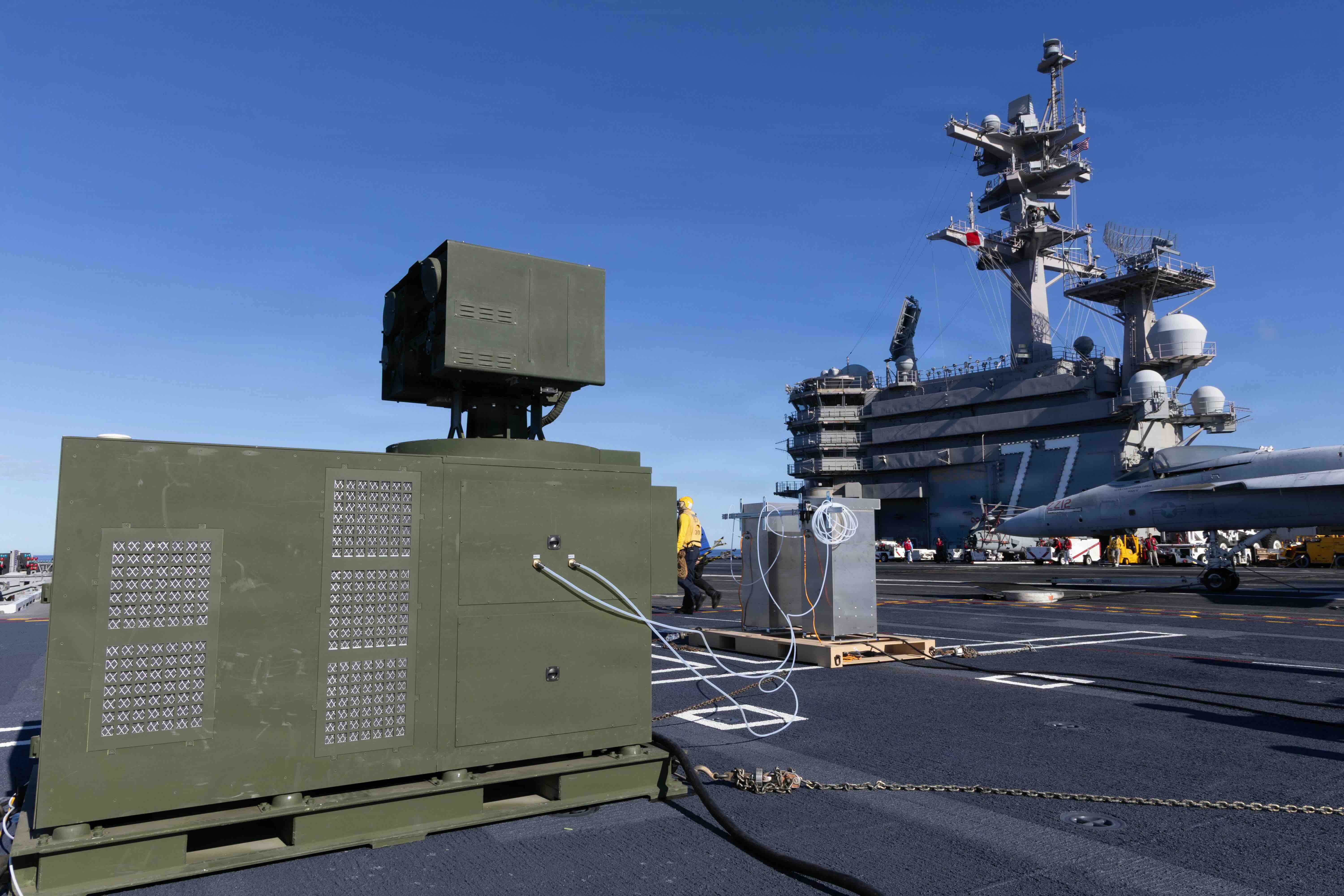
The U.S. Navy tested AeroVironment’s LOCUST Laser Weapon System (LWS) aboard USS George H.W. Bush (CVN-77) in the Atlantic Ocean on October 5, 2025, confirming the result April 20, 2026, 197 days after the event. The Palletized High Energy Laser (P-HEL) variant detected, tracked, and neutralized multiple unmanned aerial vehicles (UAVs), in what appears to be the first laser weapon live-fire conducted from a U.S. aircraft carrier.
BREAKING: The US Navy Tested a Laser Weapon on an Aircraft Carrier At Sea
Photos published to @DVIDSHub show a containerized LOCUST Laser Weapon System from defense contractor AV set up on the flight deck of the Nimitz-class aircraft carrier USS George H.W. Bush for a live-fire… pic.twitter.com/RX98gcFu3t
— Laser Wars (@laserwarsHQ) April 20, 2026
The test was conducted jointly with the U.S. Army Rapid Capabilities and Critical Technologies Office (RCCTO), AeroVironment announced April 21, 2026. The containerized, 20-to-26-kilowatt system was lashed to the carrier’s flight deck without structural modification.
“Rolling LOCUST onto a ship and quickly initiating operations facilitates the expanded use of high-energy lasers across the Fleet without the need for costly ship modifications,” said John Garrity, Vice President of Directed Energy Systems at AeroVironment.
Eliminating drones at the speed of light—on any platform, in any domain, for any mission.
“Rolling LOCUST onto a ship and quickly initiating operations facilitates the expanded use of high-energy lasers across the Fleet without the need for costly, time-consuming ship… pic.twitter.com/oVqHorR7BB
— AV (@aerovironment) April 21, 2026
The Navy released the imagery at the opening of the Naval League’s Sea-Air-Space exposition. Vice Chief of Naval Operation Admiral James Kilby told reporters he is “not ready to go all in yet on buying these things,” citing the need for reliably consistent output before any fleet-wide commitment.
The Navy’s sole operational shipboard laser, the Lockheed Martin High Energy Laser with Integrated Optical-Dazzler and Surveillance (HELIOS) system aboard USS Preble, has not reached its advertised 60-kilowatt output, Kilby has stated.
His superior officer holds a more aggressive position. Admiral Daryl Caudle, the current Chief of Naval Operations, said in January 2026 that “point defense needs to shift to directed energy,” citing the advantage of an “infinite magazine.”
Houthi forces have forced the Navy to expend interceptors costing hundreds of thousands of dollars each against low-cost drones in the Red Sea since late 2023. Laser engagements run approximately $3 to $5 in electricity per shot.
🇺🇸 The U.S. Navy just tested a containerized LOCUST Laser Weapon System on the flight deck of the USS George H.W. Bush carrier at sea.
It detected, tracked, engaged, and neutralized multiple drones in a live-fire test, a big milestone for ship-based directed energy weapons.… https://t.co/vCr4GYQTI2 pic.twitter.com/uw1U6ZvE9f
— Mario Nawfal (@MarioNawfal) April 21, 2026
Detect. Track. Defeat.
Introducing the LOCUST X3: A modular advancement in directed energy, delivering precise, speed-of-light engagement against evolving threats. Its scalable system features a more powerful laser source—detecting, tracking, and defeating Group 3 UAS threats at… pic.twitter.com/5tZfoFoH33
— AV (@aerovironment) March 24, 2026
AeroVironment revealed LOCUST X3, a third-generation, AI-enabled successor to the system tested aboard CVN-77, on March 24, 2026, less than four weeks before the carrier test was publicly disclosed, leaving the Navy to determine which generation to field.