
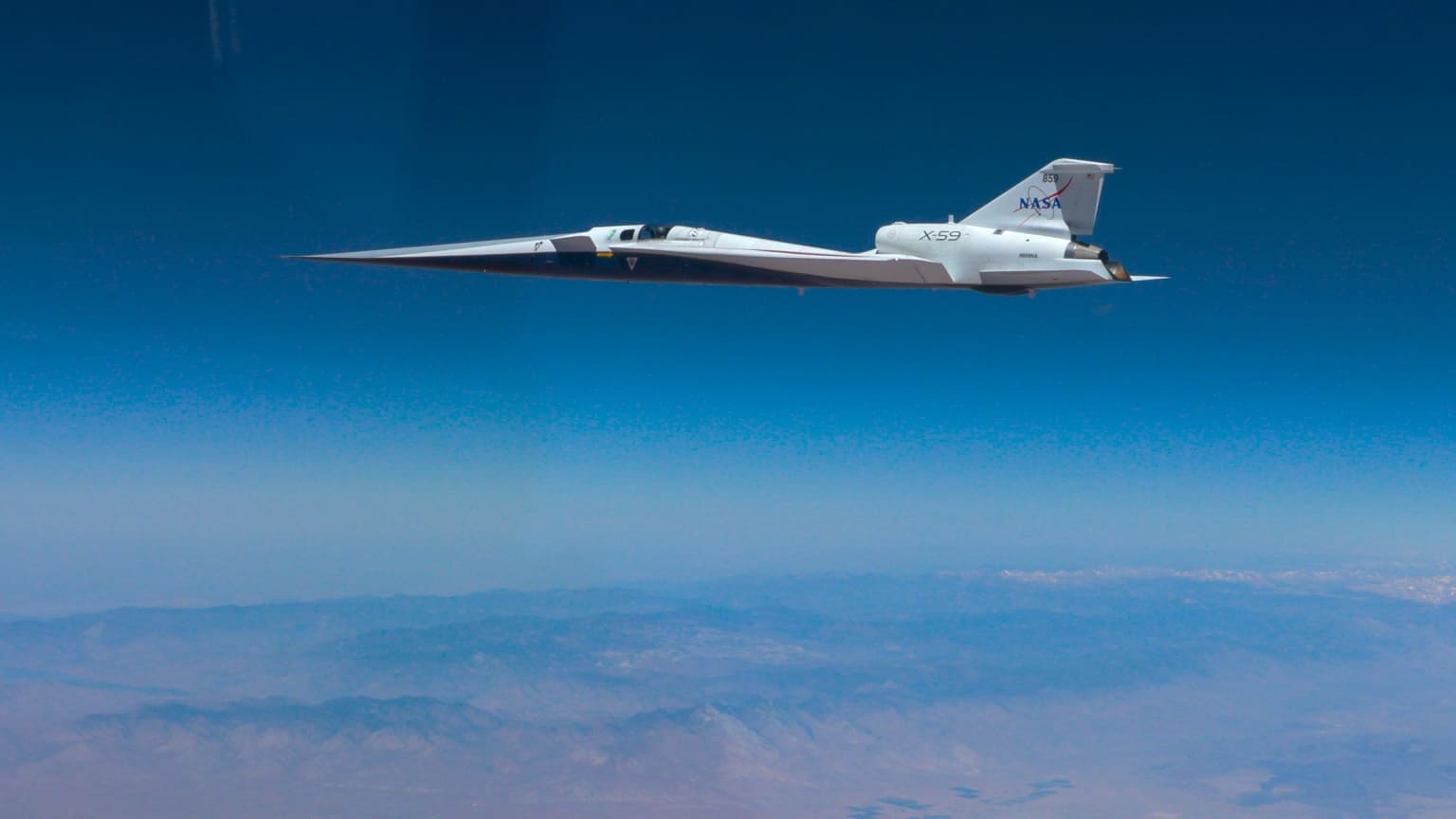
NASA’s experimental X-59 aircraft has completed its first supersonic flight, marking a major milestone in the agency’s effort to develop quieter high-speed air travel that could potentially pave the way for commercial supersonic flights over land.
The X-59, part of NASA’s Quiet SuperSonic Technology (Quesst) mission, exceeded the speed of sound during a test flight from Edwards Air Force Base in California on June 5, according to a NASA press release.
The agency said test pilot Jim “Clue” Less flew the aircraft during the 81-minute mission, during which it reached approximately Mach 1.1 (713 mph), and climbed to an altitude of 43,400 feet.
A NASA F-15 served as a safety chase aircraft during the mission. NASA said “the loud sonic booms from the F-15 obscured any sound made by the X-59.”
✈️ JUST IN: The X-59 has gone supersonic!
The X-59 achieved supersonic speeds for the first time ever today — a major milestone for NASA’s Quesst mission and an important step toward upcoming flights that will demonstrate its quiet supersonic technology ahead of future… pic.twitter.com/mwblICs4vN
— NASA Aeronautics (@NASAaero) June 5, 2026
The flight marked the first time the X-59 entered the supersonic portion of its flight envelope since making its maiden flight in October 2025.
Developed by NASA and Lockheed Martin’s Skunk Works, the X-59 is designed to address one of the biggest obstacles to supersonic passenger travel: the loud sonic boom produced when aircraft exceed the speed of sound.
Unlike traditional supersonic aircraft, the X-59 is engineered to generate only a quiet thump on the ground rather than the disruptive boom that prompted regulators to ban commercial supersonic flights over land in many countries decades ago.
Shorter flight times, quieter booms: see how NASA’s X-59 experimental airplane could revolutionize supersonic flight in the documentary “X-59: NASA’s Quesst for Supersonic Flight,” streaming now for free on NASA+. https://t.co/7a6FTvxBwE pic.twitter.com/B5YJCTqsjH
— NASA (@NASA) December 30, 2024
“X-59 is getting ready for its quiet supersonic debut,” NASA Administrator Jared Isaacman said. “Since the aircraft’s first flight on Oct. 28, 2025, the team has made tremendous progress, flying 16 times in the last 90 days and getting into a steady test rhythm.”
According to NASA, in the coming days the aircraft is expected to conduct its first “mission conditions” flight, during which it will be pushed to a cruising speed of Mach 1.4 (925 mph) and an altitude of approximately 55,000 feet.
The X-59 will also be accompanied by a chase plane during the flight.