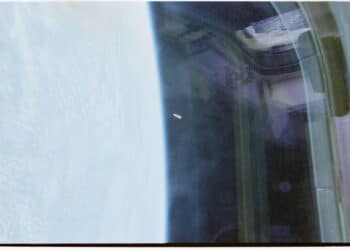

A bolide, a type of ultra-bright fireball, exploded over northeastern Massachusetts at 2:06 p.m. EDT on May 30, 2026, dropping debris into Cape Cod Bay, NASA confirmed. It released energy equivalent to 300 tons of TNT and generated sonic booms felt from Delaware to Ontario, Canada.
NASA said the object was approximately five feet wide with a mass of 5.6 metric tons, entering the atmosphere at 42,000 mph and traveling 26 miles before breaking apart at an altitude of 31 miles. NOAA’s Geostationary Operational Environmental Satellite-19 (GOES-19) independently detected the atmospheric flash.
#MeteorSighting: Eyewitnesses in New England and @NOAA’s GOES-19 satellite reported a bright fireball on Saturday, May 30, at 2:06 p.m EDT accompanied by a loud noise. The meteor appears to have fragmented at an altitude of 40 miles over northeast MA and southeast NH. The energy…
— NASA Space Alerts (@NASASpaceAlerts) May 30, 2026
The American Meteor Society (AMS) logged more than 80 witness reports from Delaware to Ontario, Canada. AMS program monitor Robert Lunsford described reports of a double boom, ground shaking, and a daytime fireball across the region.
The U.S. Geological Survey (USGS) confirmed sensors registered a sonic boom but recorded no seismic activity. Spokesperson Steve Sobie said the agency opened a “Did You Feel It?” event page after receiving multiple reports, though no seismographs detected earthquake activity.
NASA pinpointed the debris field approximately 10 miles northeast of Sandwich Harbor at a water depth of 34 meters in Cape Cod Bay. “This was a daytime bolide that produced a meteorite fall right in the middle of Cape Cod Bay,” NASA stated.
Saturday’s daytime bolide #meteor that exploded over Cape Cod did show up on satellite and radar. Based on the radar signature from surrounding Doppler radars, a meteorite fall was produced right in the middle of Cape Cod Bay. So, meteorite hunters might be limited to magnets on… pic.twitter.com/2sHdaz1iVu
— Brad Panovich (@wxbrad) May 31, 2026
The Massachusetts event is the latest in a documented 2026 surge in large fireball activity. The AMS recorded 2,322 events in Q1 2026, with 40 generating 50 or more witness reports and 16 generating 100 or more, a pattern the society described as warranting investigation.
“How bright it was, how fast it was moving, the angle it was coming from, and how long it stayed bright for, that gives us a lot of information,” said Shauna Edson, an astronomy educator at the Smithsonian National Air and Space Museum.