
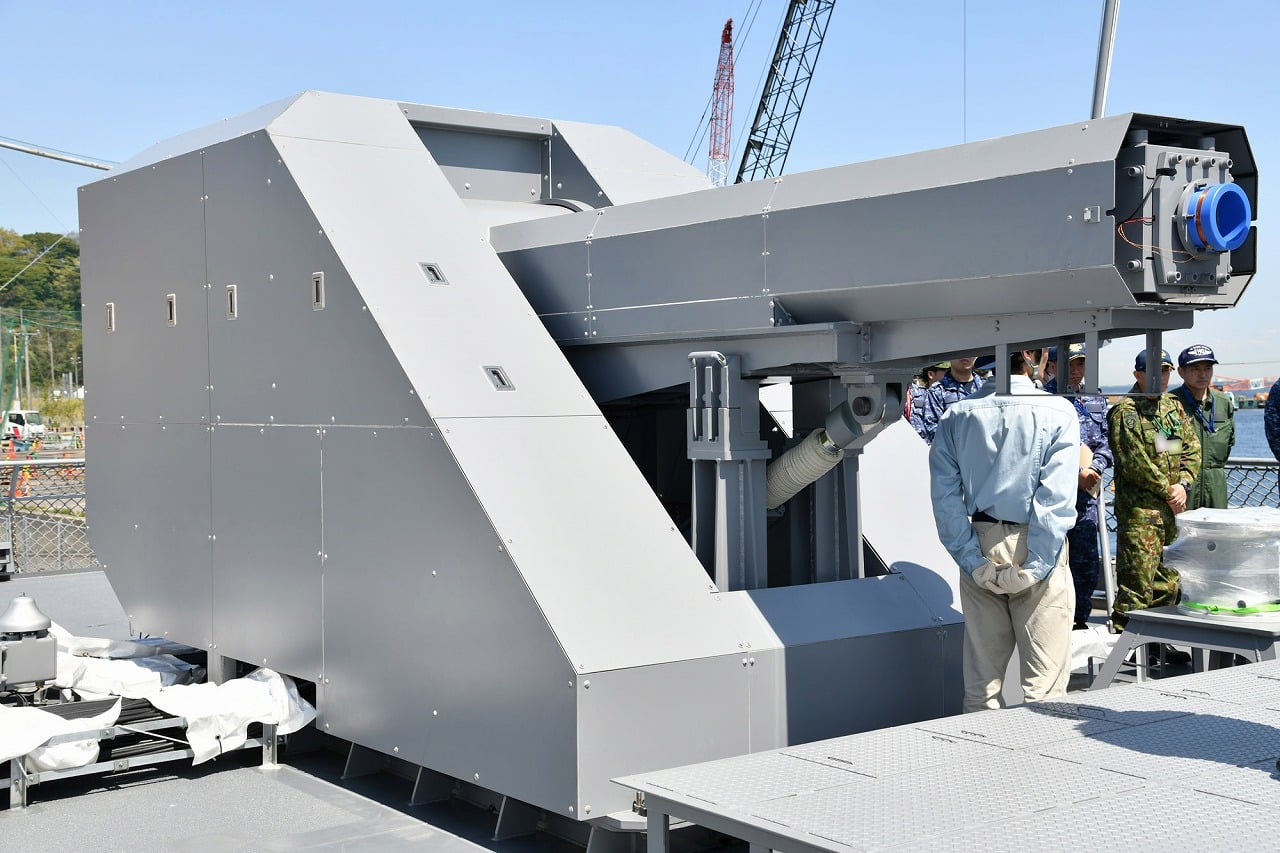
The Japan Maritime Self-Defense Force (JMSDF) publicly released images of an electromagnetic railgun prototype mounted aboard the experimental test ship JS Asuka (ASE-6102), marking a major milestone in Japan’s nearly decade-long effort to field next-generation high-velocity weapons.
The railgun, developed by the Acquisition, Technology & Logistics Agency (ATLA), has been under active development since fiscal year 2016 through a program titled “Research on Electromagnetic Acceleration Systems.” The weapon system is designed to fire kinetic projectiles at a muzzle velocity of 2,000 meters per second, with a target barrel lifespan of 120 firings.
Photos of the mounted system first surfaced online on April 9, when Twitter user モリジュン (@HNlEHupY4Nr6hRM) posted several images taken during a port tour—believed to be at Yokosuka Naval Base—showing a turret-like structure on Asuka consistent with railgun system configurations.
今日は軍港めぐりで🇯🇵海上自衛隊試験艦「あすか ASE-6102」のレールガンと思われるものが見えました😁
砲台と砲身が角張った形状です😲 pic.twitter.com/OuRHhqU4I1
— モリジュン (@HNlEHupY4Nr6hRM) April 9, 2025
The same platform hosted the world’s first known shipboard firing of a railgun in October 2023, according to ATLA statements.
#ATLA has accomplished ship-board firing test of railgun first time in the world with the cooperation of the JMSDF. To protect vessels against air-threats and surface-threats by high-speed bullets, ATLA strongly promotes early deployment of railgun technology. pic.twitter.com/MG5NqqENcG
— Acquisition Technology & Logistics Agency (@atla_kouhou_en) October 17, 2023
JS Asuka, commissioned in 1995, is the JMSDF’s only dedicated test platform and is operated by the Technology Evaluation and Development Unit.
ATLA confirmed that the railgun project has entered a new phase titled “Research on Future Railgun,” running from FY2022 to FY2026. This phase transitions the system from single-shot testing toward operational readiness, focusing on continuous firing capability, fire control integration, and projectile stability after launch.
“To protect vessels against air-threats and surface-threats by high-speed bullets, [ATLA] strongly promotes early deployment of railgun technology,” the agency stated. Enhancing the projectile’s aerodynamic performance is a critical research area, as even at hypersonic speeds, air resistance can significantly reduce range and impact effectiveness if the projectile lacks stability.
Unlike conventional guns, railguns accelerate projectiles using electromagnetic force rather than chemical propellants. While this eliminates the need for explosive ammunition, it introduces challenges such as thermal erosion of the rails and power supply demands.
ATLA’s prototype railgun weighs roughly eight tons and is equipped with a 19.6-foot (6-meter) barrel capable of launching rounds at speeds exceeding Mach 6.5. Intended operational uses include intercepting incoming anti-ship missiles, executing long-range strikes against enemy artillery, and serving as coastal defense artillery with extended reach.