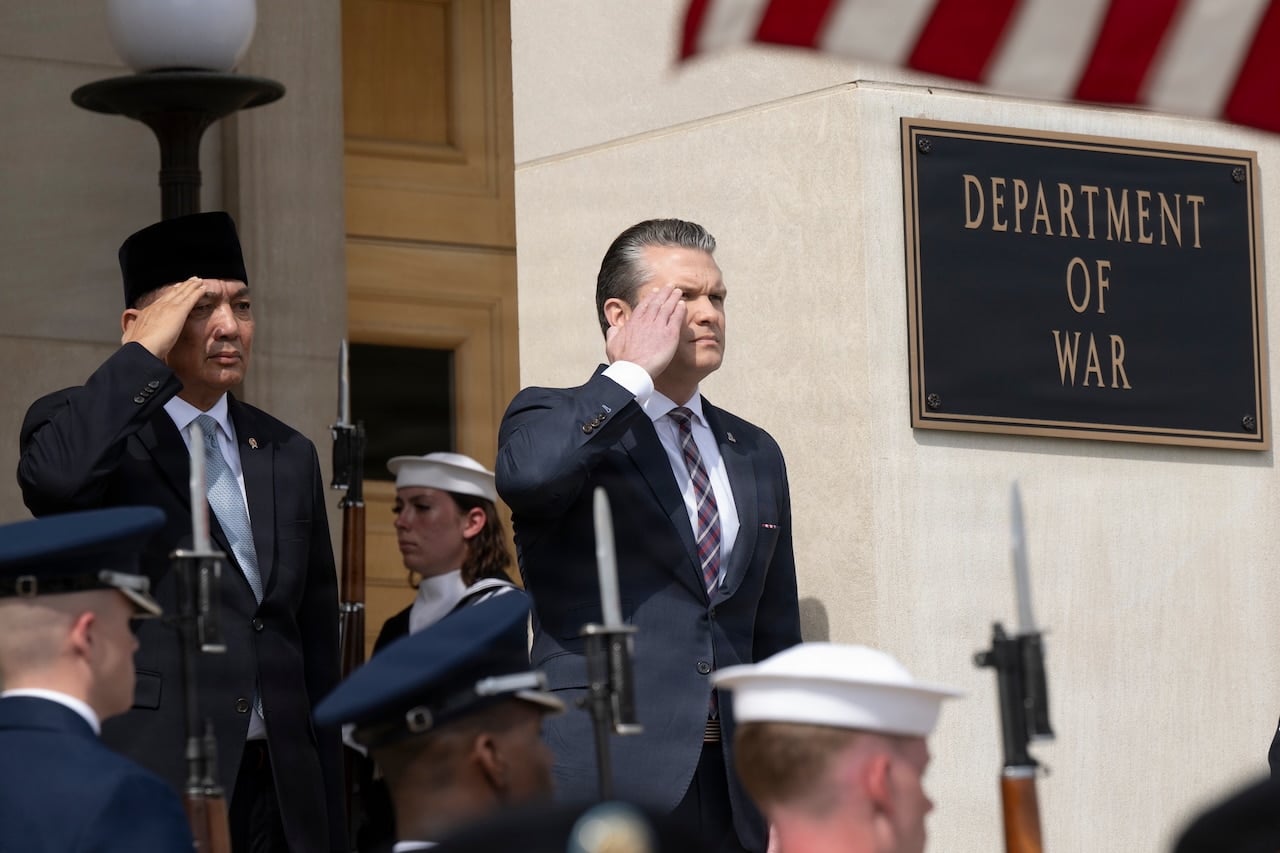
Secretary of War Pete Hegseth and Indonesian Defense Minister Sjafrie Sjamsoeddin formalized a Major Defense Cooperation Partnership (MDCP) at the Pentagon on Monday, establishing the most consequential bilateral defense framework between the two countries in decades and setting a foundation for expanded joint operations, training, and advanced technology cooperation across the Indo-Pacific.
It was an honor to host Indonesian Defense Minister @sjafriesjams at the Pentagon today.
I was proud to announce that we are elevating our relationship to a Major Defense Cooperation Partnership, in recognition of the strength and potential of our bilateral defense ties. pic.twitter.com/eyo3Jh1cWF
— Secretary of War Pete Hegseth (@SecWar) April 13, 2026
The MDCP is built on three foundational pillars grounded in each country’s national sovereignty and mutual respect. The first covers military organization and capacity building. The second addresses training and professional military education. The third governs exercises and operational cooperation.
“Your visit demonstrates the importance that the War Department places on our growing security relationship and it is active and growing with Indonesia,” Hegseth told Sjamsoeddin at the signing. The two countries conduct more than 170 joint military exercises each year, Hegseth said.
Sjamsoeddin described the partnership as a generational commitment. “We are here as Indonesian delegates with very great enthusiasm to continue to develop our defense relationship, which should be enduring for our next generation in Indonesia and the United States of America,” he said. “We are working on behalf of mutual respect and mutual benefit to enhance the value of our national interests.”
Under the MDCP, the two countries will co-develop asymmetric capabilities, advance next-generation maritime, subsurface, and autonomous systems technologies, and expand maintenance, repair, and overhaul cooperation.
The agreement also expands joint special forces training and broadens multilateral exercises, including Super GARUDA SHIELD, the annual multinational drill in which US forces conducted the first-ever FIM-92 Stinger missile live-fire on Indonesian soil during the August 2025 iteration.
The signing came the same day Indonesia’s defense ministry confirmed that Washington and Jakarta are actively negotiating a separate, non-binding Letter of Intent that would grant US military aircraft blanket overflight access through Indonesian airspace.
The preliminary draft is still being discussed internally and is neither final nor binding, the ministry stated. Any final agreement will protect Indonesia’s sovereignty and comply with Indonesian law, the ministry added.
That confirmation came three weeks after President Prabowo Subianto publicly restated Indonesia’s non-aligned posture. “We don’t want to join any pacts. We can’t accept foreign military bases. It has always been like that since Sukarno’s era,” Prabowo told journalists in March, according to the Jakarta Globe.
The overflight proposal, if finalized, would stop short of a permanent basing arrangement but would mark a departure from the case-by-case airspace approvals Indonesia has historically required of foreign militaries.
Indonesia’s airspace spans territory that includes the Lombok and Sunda Straits, two of the Indo-Pacific’s most strategically significant maritime passages.
Both Hegseth and Sjamsoeddin described the MDCP as a “line of departure,” a military term for initiating a new mission.
“Here’s to the next chapter and our new mission together for our great countries,” Hegseth said.