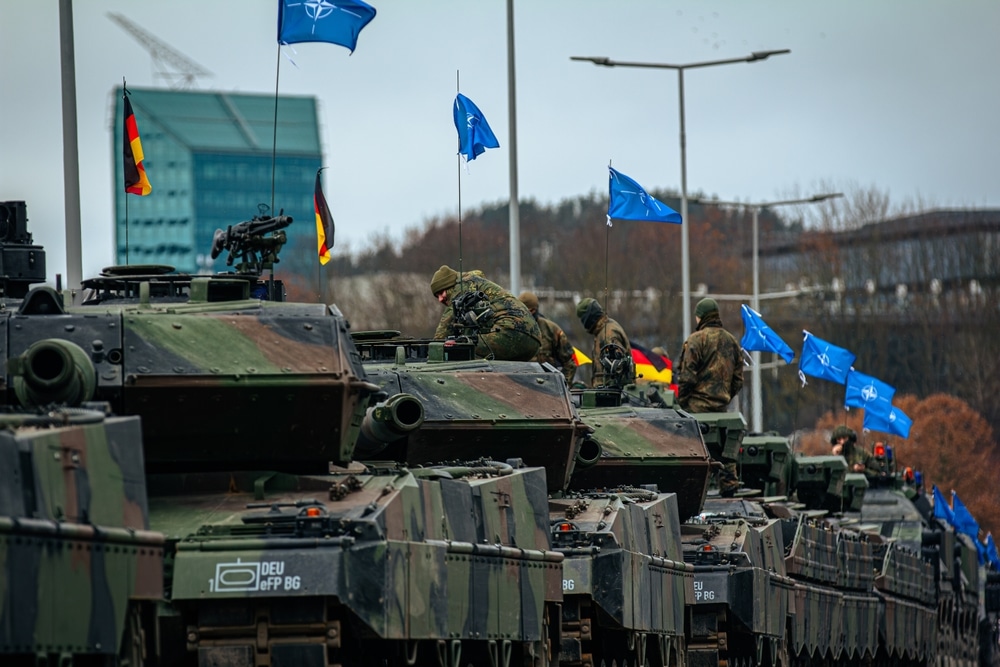
Germany unveiled its first standalone military strategy in Berlin on April 22, setting a goal of 460,000 combat-ready troops and positioning the Bundeswehr as Europe’s strongest conventional force by 2039, as Defense Minister Boris Pistorius acknowledged the force is building its long-range precision strike capability from scratch.
🖥️ Germany wants to recruit a minimum of 460,000 military personnel ready for deployment: this is more than the number of available positions, said the head of the German Defense Ministry, Boris Pistorius
“The goal is to have at least 460,000 ready-to-deploy military personnel,… pic.twitter.com/8UjRJ7M1q9
— Elisabeth Eliseeva 🇷🇺 AKHMAT (@Eliseevanews) April 22, 2026
Titled “Verantwortung für Europa” (Responsibility for Europe), the strategy names Russia as the primary threat and introduces a “one theater approach,” treating NATO territory, the Middle East, and the Indo-Pacific as a single interconnected security space rather than separate theaters.
A historic first for the🇩🇪 army (Bundeswehr): a military strategy that defines how the Bundeswehr does deterrence and how it operates in case of war. More new documents: the army‘s capability profile, the personnel and reservists‘ growth plan, a red tape cut/modernisation plan. pic.twitter.com/4wzCRllj8O
— Nina Haase-Trobridge 🇪🇺 (@NinaHaase) April 22, 2026
The accompanying capability profile replaces fixed hardware quotas for tanks, aircraft, and ships with effects-based planning.
“The question is not how many battalions the German army needs, but what effects it must be able to produce,” Pistorius said. Deep precision strike, air defense against hypersonic missiles, and drone operations are listed as priority areas.
The growth plan calls for expanding active-duty strength from 185,420 soldiers to 260,000 by the mid-2030s, with the reserve rising from roughly 60,000 to at least 200,000 in parallel.
Section 91 of the Soldiers’ Act (Soldatengesetz, SG), in force since January 1, 2026, enshrines those milestones in law and embeds conscription as a fallback if voluntary recruitment targets are missed. Deputy Inspector-General Nicole Schilling said applications are running 20% above last year’s pace, with recruitment up 10%.
The reserve, long treated as a secondary force, is now formally positioned “on par with the active force.” Pistorius called it “the hinge between the military and civil society,” with reservists earmarked for homeland defense and logistics support for allied forces moving east.
Pistorius acknowledged that surging demand for air defense systems in the Middle East has compressed global production capacity. “We have the money and we’ve triggered procurement,” he said. “But we don’t control all the variables.”