For years, U.S. defense leaders have identified the same persistent vulnerability: resilient communications at the tactical edge. As near-peer adversaries refine electronic warfare capabilities and contested spectrum operations become the norm rather than the exception, legacy communications systems are increasingly exposed.
Elsight is positioning itself directly at the center of that problem.
The company’s flagship platform, Halo, is designed to ensure continuous, low-signature beyond line-of-sight (BLOS) connectivity for unmanned systems, sensors, and edge nodes operating in contested environments. Unlike many emerging technologies in the defense space, Halo isn’t conceptual, it’s already operationally validated.
An Operator’s Perspective
From Ryan Garay, Elsight’s Head of U.S. Government & Special Programs, the company sits at a critical intersection of operational need and proven capability.
“Elsight sits at a very real intersection of operational need, proven technology, and near-term impact, which is ultimately what drew me to the company,” Garay said.
Garay spent his active-duty career in the U.S. Army Special Forces as a Communications Sergeant (18E). Since transitioning out of the military, he has worked across the defense industry with companies including L3Harris, Persistent Systems, IBM, and Vantor/Maxar, supporting SOCOM, JSOC, and broader Department of Defense modernization efforts.
Across those roles, one issue remained constant: resilient BLOS connectivity at the tactical edge is both mission-critical and extremely difficult to solve.
“Across all of those roles, resilient connectivity at the tactical edge has consistently been one of the hardest, and most mission-critical, problems to address,” Garay explained.
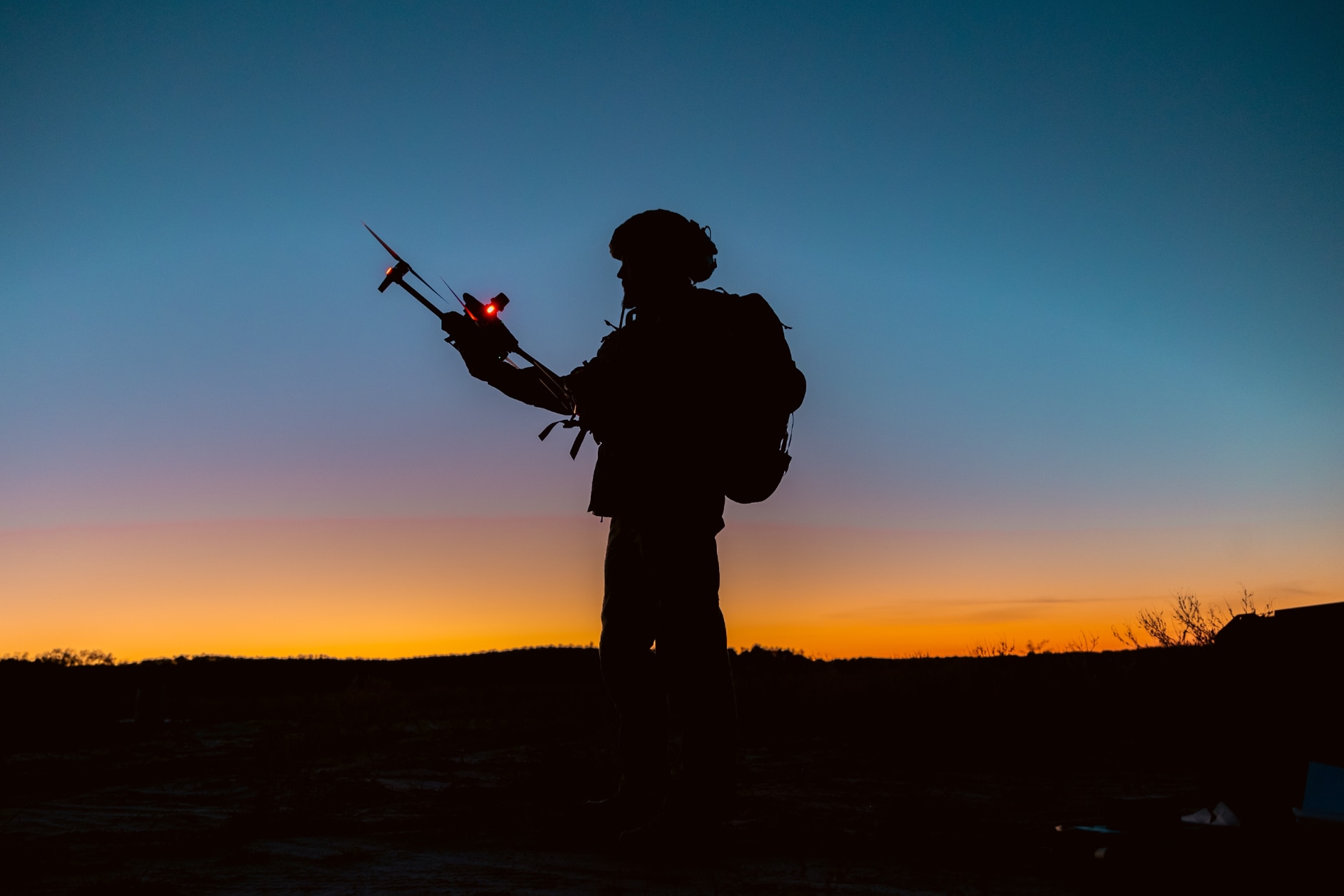
Modern unmanned systems rely heavily on communications links to operate. Traditionally, those links depend on RF-based systems operating across VHF and UHF bands. While effective in permissive environments, these systems emit detectable signatures and are increasingly vulnerable to electronic warfare.
In contested environments, once a signal is detected, it can be targeted. Once jammed, the platform becomes inoperable.
Mission failure, in many cases, is a communication failure.
For years, modernization conferences have emphasized interoperability, seamless integration, and low-latency connectivity. Yet acquisition timelines and reliance on legacy architectures have slowed progress.
Elsight’s approach addresses the problem directly.
What Halo Does — In Practical Terms
Halo is a multi-bearer connectivity layer rather than a radio replacement that integrates onto unmanned platforms and robotic systems, enabling them to dynamically utilize multiple transport pathways, including LTE, 5G, SATCOM, P2P/MANET and other available links.
Rather than relying on a single communications method, Halo bonds all available networks, using a logic later to steer traffic to the healthiest path. If one pathway degrades, is jammed, or loses line-of-sight capability, the system automatically shifts to another with minimal latency.
“What stood out immediately about Elsight is that Halo isn’t aspirational or conceptual, it’s operationally proven,” Garay said. “The platform is already being used globally in real-world, contested environments to keep unmanned systems, sensors, and edge nodes connected using a true multi-bearer approach.”
By leveraging commercial infrastructure where appropriate and minimizing high-power emissions, the system reduces signature exposure and increases survivability.
Operationally Proven — Not Theoretical
Elsight reports more than 500,000 operational hours in contested environments, in several areas of conflict worldwide.
That level of operational validation differentiates Halo from early-stage technologies still in testing phases.
“That operational maturity, combined with the pace of customer adoption we’re seeing, made the decision very clear for me,” Garay noted.
In a defense acquisition environment increasingly focused on rapid fielding and near-term impact, operational proof matters.
Positioned for the Future of Edge Warfare
Recently, Elsight was awarded the BLOS connectivity portion of the U.S. Defense Innovation Unit (DIU)’ s Project Gl and is currently in the final stages of training special forces. Overall, Elsight’s Halo has succeeded in demonstrating in front of several DoW’s various units, receiving positive feedback on Halo’s resiliency and adaptiveness in contested environments. Autonomous systems, AI-enabled analytics, and edge computing all depend on resilient, adaptive connectivity.
Future operations will demand:
- Low-signature communications
- Seamless interoperability
- Dynamic network management
- Resilience under persistent electronic attack
Elsight’s near-term execution aligns with current operational realities, while its longer-term roadmap anticipates where autonomous systems, edge computing, and resilient networking are heading.
“The near-term focus is sharply aligned to current operational and acquisition realities,” Garay said. “At the same time, the roadmap clearly anticipates where autonomous systems and resilient networking are going.”
Equally important, he emphasizes that automation should enhance, not replace, human judgment.
“The key is to leverage AI and advanced networking to their fullest potential while keeping the operator in the loop,” Garay explained. “Technology should enable mission success, not remove human decision-making.”
Closing the Gap
For years, communications in contested environments have been identified as a capability gap. As adversaries continue to advance electronic warfare capabilities, the ability to maintain uninterrupted connectivity at the tactical edge that will increase lethality, safety, and modularity will only grow in importance.
Elsight is betting that the future of battlefield superiority will not be defined solely by new platforms, but by the resilience of the networks connecting them.
If Halo’s operational performance continues at scale within U.S. defense environments, the longstanding communications gap may finally have a credible solution.
To learn more about Elsight and the Halo platform, visit elsight.com.