
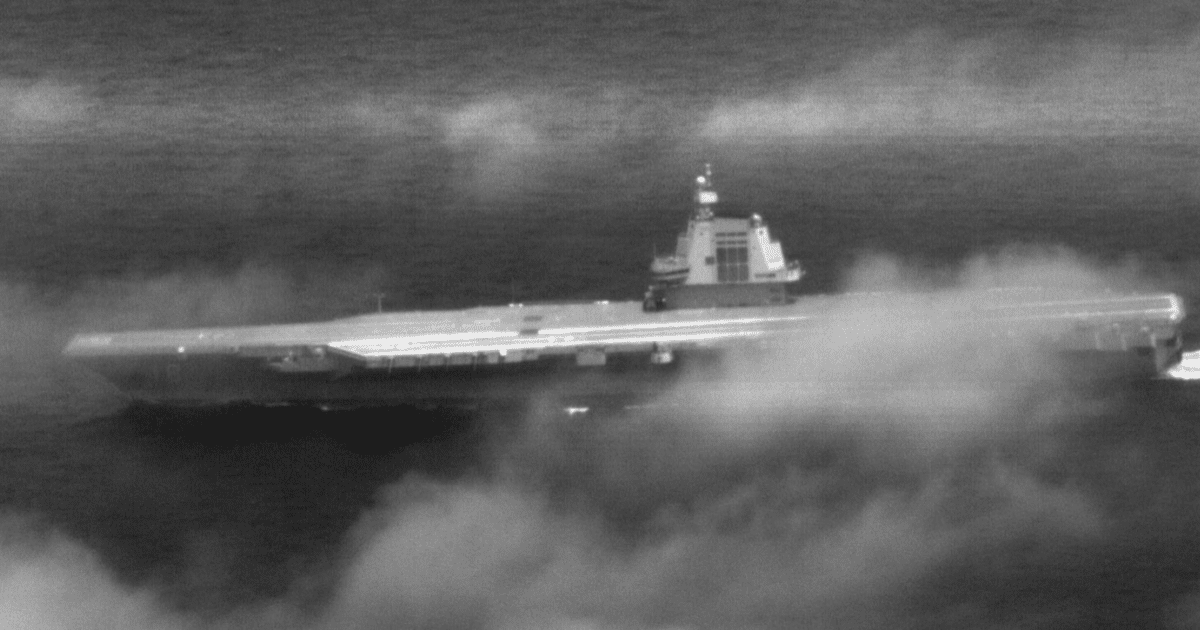
China’s Fujian aircraft carrier transited the Taiwan Strait on Tuesday, June 23, Taiwan’s Ministry of National Defense (MND) confirmed, the carrier’s first such passage since December 2025.
PLAN aircraft carrier CV-003 Fujian transits the Taiwan Strait. Similar to other Chinese naval movements in this area, what until quite recently caused significant headline stir will in the near future turn into a rather frequent phenomenon https://t.co/F9HbOkMDiU
— Alex Luck (@AlexLuck9) June 23, 2026
The transit came as two exercises started Monday. Taiwan launched a five-day Immediate Combat Readiness Exercise to test its response to a potential Chinese invasion, while U.S. Indo-Pacific Command began Valiant Shield 2026, a multinational drill running through July 1 across Guam, Japan, and the Mariana Islands.
Taiwan’s MND released a surveillance photo showing the Fujian’s deck empty of aircraft and confirmed the military closely monitored the passage using joint intelligence, surveillance, and reconnaissance assets.
Song Zhongping, a former People’s Liberation Army (PLA) instructor, told South China Morning Post the empty deck suggested a low-threat state, with the carrier likely returning to its Hainan homeport.
The Fujian is the world’s largest conventionally powered warship at roughly 80,000 tons and China’s first to feature an electromagnetic aircraft launch system (EMALS), making it the second country after the U.S. to field the technology.
The Fujian’s transit came as China’s Liaoning carrier strike group (CSG) returned to Qingdao on Monday after a 40-day deployment to the South China and Philippine Seas. The People’s Liberation Army Navy (PLAN) said the CSG conducted joint exercises with amphibious assault ship CNS Anhui (33), the first publicly confirmed drills of their kind.
On Wednesday, the U.S. State Department called Chinese Coast Guard patrols off Taiwan’s east coast “deeply destabilizing.” China’s Taiwan Affairs Office said the patrols, launched in response to Japan-Philippines maritime boundary talks Beijing disputes, were “lawful, legitimate and necessary.”
Echoing Washington’s concerns, the British, French, and German offices in Taipei issued a joint statement warning the activity threatened “regional stability and the freedom of navigation and safety of international shipping.”