
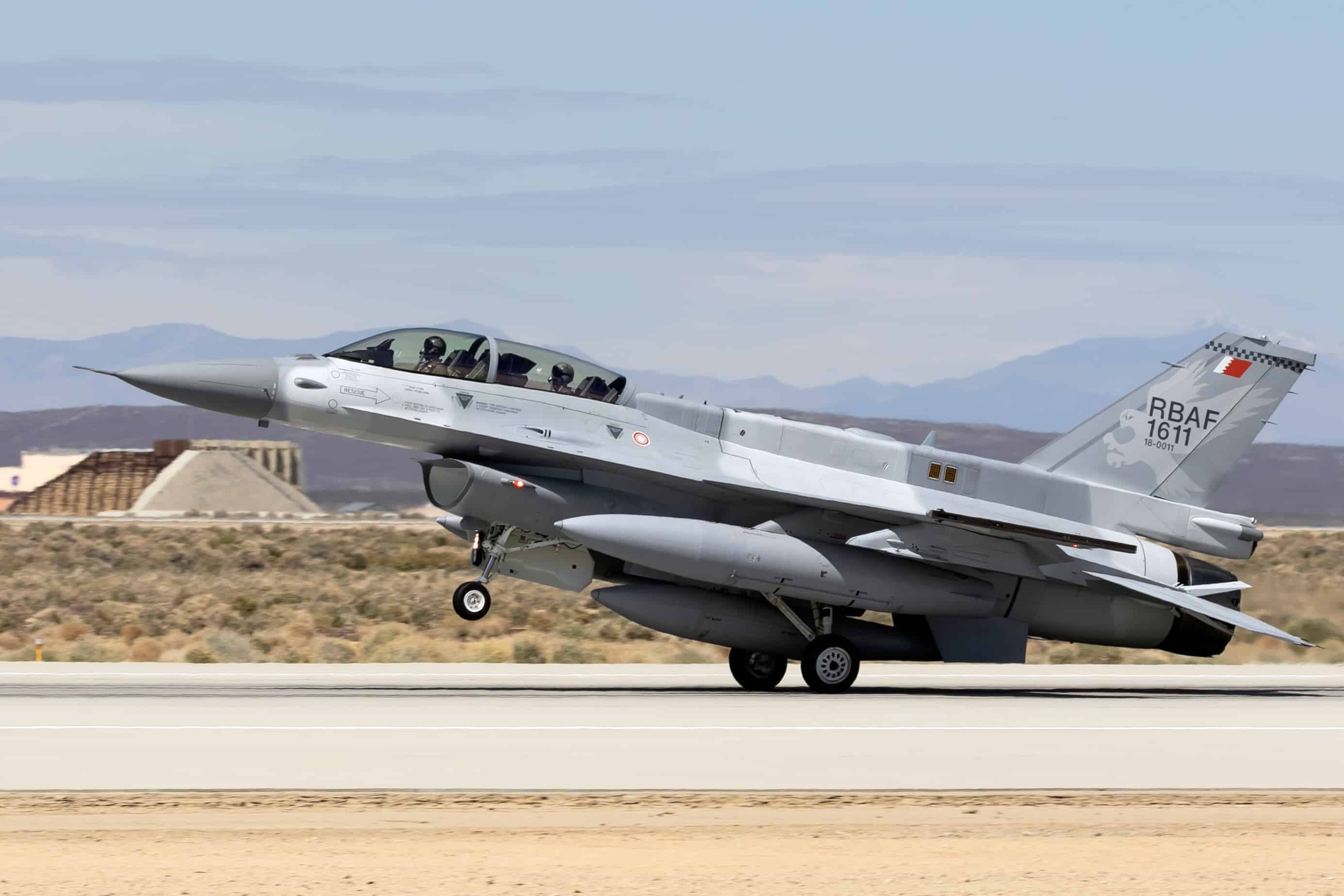
Lockheed Martin’s F-16 Block 70 has drawn first blood. Royal Bahraini Air Force (RBAF) pilots flying the F-16D variant shot down two Iranian Shahed drones on April 1, scoring the newest production F-16’s first confirmed air-to-air kills less than 13 months after the type arrived in Bahrain.
The engagement was first reported by Aviation Week’s Steve Trimble, citing a source familiar with the matter.
Lockheed Martin confirmed the kills on April 9, posting a photograph of an RBAF F-16D Block 70 with the caption: “Proven in combat. Two hostile unmanned aerial vehicles eliminated.”
Proven in combat. ✅ Two hostile unmanned aerial vehicles eliminated. https://t.co/D6quWCzp0N pic.twitter.com/rvc32TJBpW
— Lockheed Martin (@LockheedMartin) April 9, 2026
The drones had reportedly evaded ground-based defenses before RBAF fighters intercepted them. The specific missiles used have not been confirmed, though the F-16D Block 70’s standard air-to-air loadout includes the AIM-120 AMRAAM and AIM-9X Sidewinder.
The Block 70 is the most capable production variant of the F-16 Fighting Falcon, a lineage now spanning more than 50 years and 4,500 aircraft. Its defining upgrade is the AN/APG-83 Active Electronically Scanned Array (AESA) radar, which draws hardware and software commonality from the F-22 and F-35 sensor suites.
Compared with mechanically scanned predecessors, the APG-83 offers meaningfully improved detection of small, slow-moving targets, precisely the profile presented by Iranian Shahed drones.
Additional improvements include a new Modular Mission Computer, advanced cockpit displays, conformal fuel tanks, and a 12,000-hour structural service life.
Bahrain has a particular history with both the F-16 and the Block 70. The Kingdom was the first Gulf Cooperation Council state to operate the F-16 in any variant, beginning in the early 1990s, and became the launch customer for the Block 70 when three jets departed Lockheed Martin’s Greenville, South Carolina facility in 2024.
On the move! ✈️ The very first F-16 Block 70 ferry is now en route to Bahrain! This jet represents a significant leap in 4.5 generation fighter technology, revolutionizing operational capabilities and redefining 21st-century aerial combat for air forces worldwide. pic.twitter.com/yWHIvgA0uz
— Lockheed Martin (@LockheedMartin) March 6, 2024
The Bahrain Defense Force has reported intercepting 194 Iranian missiles and 515 drones targeting the kingdom since Iran began its first strikes on February 28, according to figures released April 9. The intercepts were carried out by a layered air defense network that includes Patriot PAC-3 and NASAMS batteries.
تُعلن القيادة العامة لقوة دفاع البحرين أن منظومات الدفاع الجوي بقوة دفاع البحرين بفضلٍ من الله، ثم بيقظة رجالها مستمرة في مواجهة موجات تتابعية من الاعتداءات الإيرانية الإرهابية الآثمة، استهدفت مملكة البحرين.https://t.co/QOpL6Y7f8j pic.twitter.com/SAWREZ5x1k
— قوة دفاع البحرين (@BDF_Bahrain) April 9, 2026
Bahrain hosts the U.S. Navy’s Fifth Fleet at Naval Support Activity Bahrain and has remained a target of Iranian and Iran-aligned strikes throughout the ongoing conflict. Iranian ballistic missile and drone attacks have continued against Gulf states despite the two-week U.S.-Iran ceasefire announced earlier this month.






Farcical, shooting down a $20K drone with a $1.97 million dollar missile, very poor economics.