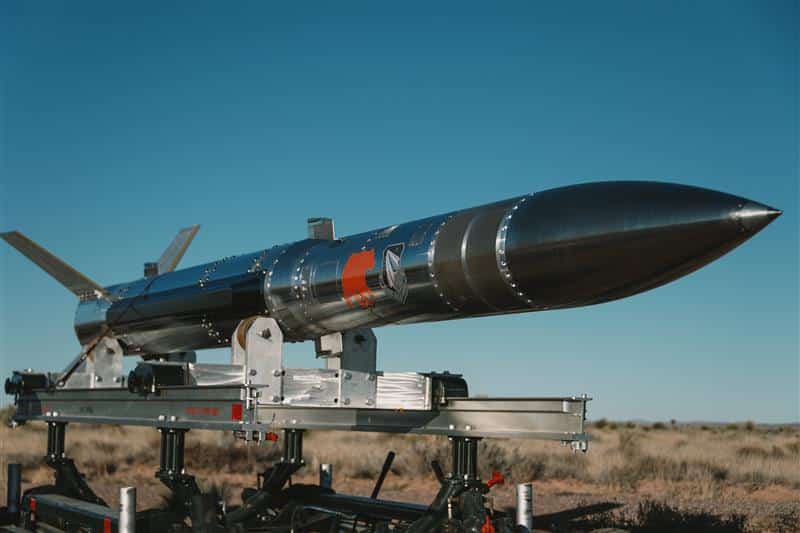
The Air Force Research Laboratory and propulsion company Ursa Major flew the Affordable Rapid Missile Demonstrator (ARMD) on March 6, reaching supersonic speeds in a test that marks the first flight of a hypersonic-class missile powered by a storable liquid rocket engine.
FLIGHT-PROVEN FROM ENGINE TO ALL-UP ROUND.
Ursa Major’s Draper storable liquid rocket engine just powered the first flight of Air Force Research Laboratory’s Affordable Rapid Missile Demonstrator—reaching supersonic speeds and achieving intended objectives on it’s maiden…
— Ursa Major (@ursamajortech) March 12, 2026
“This project proves that we can transform and leverage our acquisition models to rapidly deliver critical technology advancements to deter and win in a future conflict,” said Air Force Brig. Gen. Jason Bartolomei, AFRL commander and Air Force technology executive officer. “We are not just building a single missile. We are forging a new path toward a cost-effective, mass-producible deterrent for the nation.”
#AFRL and @ursamajortech recently executed a flight powered by the Draper liquid rocket engine.
This flight is an innovative step in the advancement of capabilities that strengthen deterrence and provide rapid global strike options for the @DeptofWar: https://t.co/VQvbdbyHHZ pic.twitter.com/51p1ToRq2w
— Air Force Research Lab – AFRL (@AFResearchLab) March 13, 2026
The ARMD used Ursa Major’s Draper engine, a storable, closed-cycle liquid rocket engine, meaning it carries its own fuel and oxidizer internally for high efficiency, and runs on non-toxic propellants stable across a wide temperature range, unlike cryogenic systems used in traditional launch vehicles.
The engine is throttleable and capable of thrust vectoring, which allows powered maneuver throughout flight. Boost-glide systems cannot do this because they are unpowered in the glide phase.
Ursa Major CEO Chris Spagnoletti said the company moved from contract award to a flight-ready vehicle in eight months. “This flight proves that you can get a vehicle with a safe, storable and throttleable liquid engine in the air quickly and affordably,” Spagnoletti said.
Katrina Hornstein, Ursa Major’s ARMD program manager, told Breaking Defense that affordability shaped every design decision. The company leveraged additive manufacturing to reduce part counts, drew from automotive and broader industrial supply chains, and kept engineering, manufacturing, and testing co-located to run all three in parallel.
“ARMD represents a key milestone in our efforts to develop revolutionary, affordable and scalable liquid rocket engine technologies to win the wars of tomorrow,” said Dr. Javier Urzay, AFRL rocket propulsion division chief.
Ursa Major subsequently unveiled the HAVOC Missile System, a medium-range hypersonic weapon also powered by the Draper engine, on February 24 at the Air and Space Forces Association (AFA) Air Warfare Symposium, with a target unit cost below $3 million.
UNLEASHING HAVOC.
Today at #AFAColorado we announced the Ursa Major HAVOC Missile System — a hypersonic weapon built for affordable mass, rapid fielding, and scalable production to arm the United States with overmatch against adversaries.If you're onsite at AFA Warfare… pic.twitter.com/3c8qZixd02
— Ursa Major (@ursamajortech) February 24, 2026