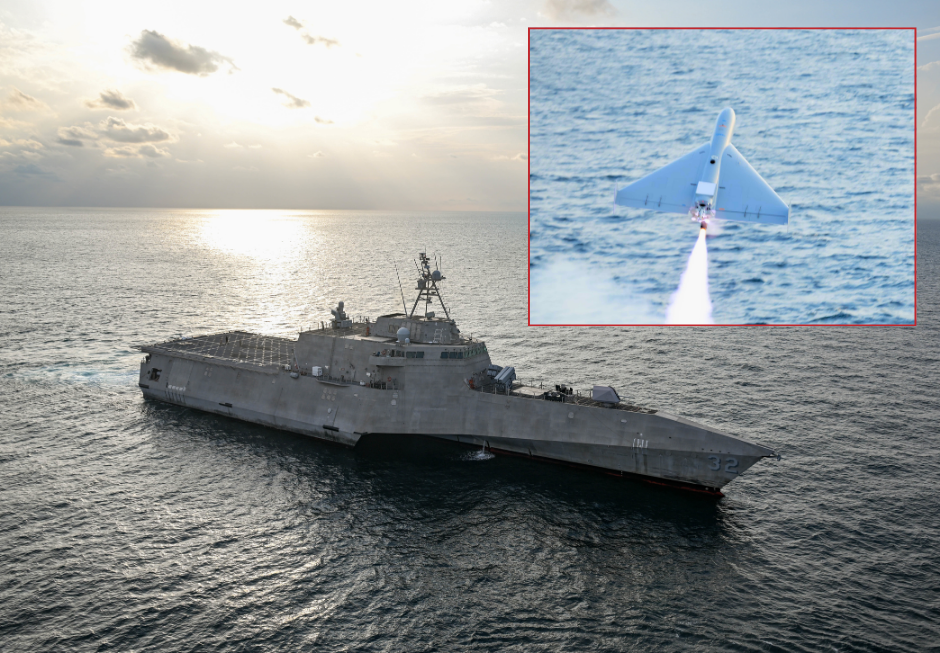
The U.S. Navy has launched a one-way attack drone from a warship at sea for the first time, marking a significant expansion of American strike capabilities in the Middle East.
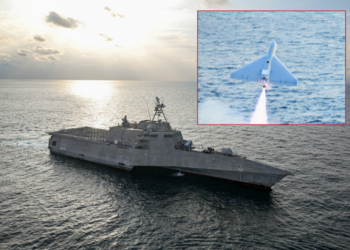
Personnel assigned to U.S. Naval Forces Central Command (NAVCENT) and U.S. 5th Fleet successfully launched a Low-cost Unmanned Combat Attack System (LUCAS) drone from the flight deck of the Independence-class littoral combat ship USS Santa Barbara (LCS 32) in the Arabian Gulf on Dec. 16.
“This first successful launch of LUCAS from a naval vessel marks a significant milestone in rapidly delivering affordable and effective unmanned capabilities to the warfighter,” said Vice Adm. Curt Renshaw, commander of NAVCENT/5th Fleet. “This achievement demonstrates the power of innovation and joint collaboration in this critical region.”
“Bravo Zulu. U.S. Navy forces in the Middle East are advancing warfighting capability in new ways, bringing more striking power from the sea and setting conditions for using innovation as a deterrent.” – Adm. Brad Cooper, CENTCOM Commander https://t.co/TgQ4WLbph3 pic.twitter.com/WUiAVojTht
— U.S. Central Command (@CENTCOM) December 18, 2025
The launch was executed by Task Force 59, the Navy’s first unit dedicated to unmanned and autonomous operations, established in 2021. The LUCAS drone itself was provided by Task Force Scorpion Strike (TFSS), the U.S. military’s first one-way attack drone squadron, which CENTCOM announced on Dec. 3.
The LUCAS platform is a reverse-engineered derivative of Iran’s Shahed-136 drone, developed by U.S.-based SpektreWorks after American forces captured a damaged Iranian drone several years ago. At approximately 10 feet long with an eight-foot wingspan, LUCAS is slightly smaller than its Iranian predecessor and carries a reported unit cost of around $35,000.
The drones can be launched via multiple mechanisms including catapults, rocket-assisted takeoff, and mobile ground and vehicle systems. Images released by the Navy show the LUCAS departing USS Santa Barbara’s flight deck using rocket-assisted launch.
The test launch in waters near Iran could carry strategic significance. A defense official previously told ABC News that Israel’s attack on Iran in November severely degraded Tehran’s missile air defense systems, leaving it less capable of countering air threats including one-way drone attacks.
“We are essentially flipping the script on Iran,” the official said when TFSS was announced, noting that the drone system serves as a more effective deterrent because it carries less risk than manned aircraft.
Iran has notably showcased its own sea-based drone capabilities, including modified commercial vessels claimed to be capable of launching long-range kamikaze drones, cruise missiles, and ballistic missiles.
The IRGC announced the JAS 313 ad ‘Fit for Combat.’
The unmanned drones are reportedly designed to carry out reconnaissance and bombardment operations.
The drones are the eventual evolution of Iran’s attempt at creating a 5th Gen fighter which never made it past taxi trials.… pic.twitter.com/EOXE1fdvpb
— SOFX (@SOFXnetwork) March 4, 2025
NAVCENT/5th Fleet’s area of responsibility encompasses approximately 2.5 million square miles of water, including the Arabian Gulf, Red Sea, Gulf of Oman, and parts of the Indian Ocean. The region contains three critical chokepoints: the Strait of Hormuz, the Suez Canal, and the Bab al-Mandeb Strait at the southern tip of Yemen.
CENTCOM has not disclosed how many LUCAS drones have been deployed to the Middle East, stating only that “many” are operational with additional units expected as production scales up.