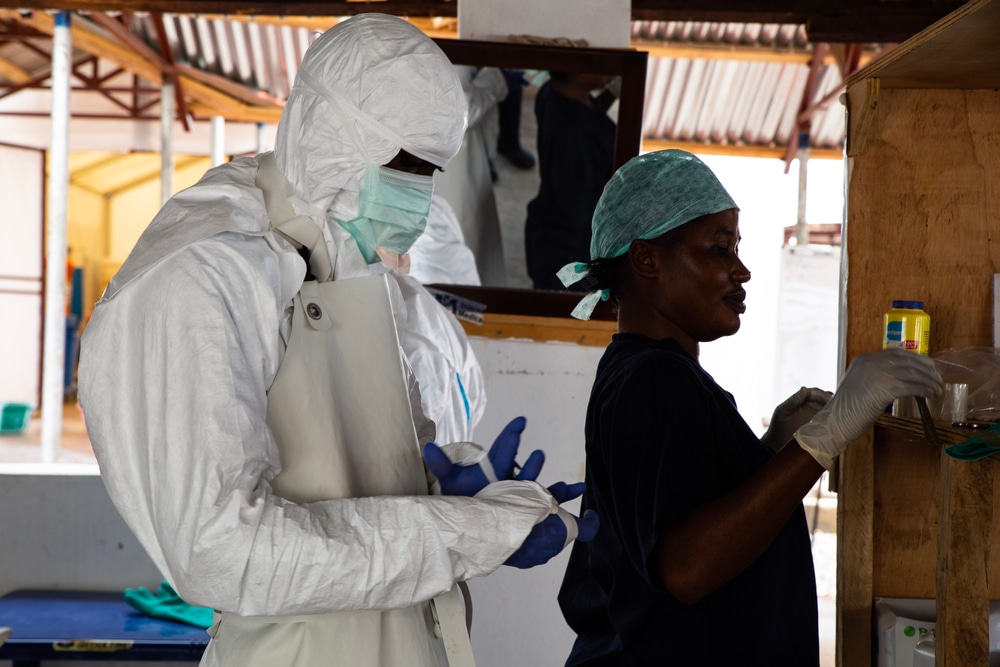
Eighteen suspected Ebola patients fled a treatment facility in Mongbwalu, eastern Democratic Republic of Congo (DRC), after unidentified assailants set fire to a Doctors Without Borders (MSF) tent at the site on the night of May 22. It was the second arson attack on an Ebola treatment center in the region within one week.
The Congolese Ministry of Communication said Sunday that suspected cases have reached 904, primarily in Ituri province, up from more than 700 reported days earlier, with 119 suspected deaths. The World Health Organization (WHO) raised the DRC’s risk level to “very high” May 22, less than a week after declaring the outbreak a public health emergency of international concern (PHEIC) on May 17.
Three Red Cross volunteers are among the outbreak’s earliest known victims, the International Federation of Red Cross and Red Crescent Societies (IFRC) confirmed Saturday. Alikana Udumusi Augustin, Sezabo Katanabo, and Ajiko Chandiru Viviane are believed to have contracted Ebola on March 27 while managing dead bodies in Djugu territory, Ituri. All three died in May, before health authorities had identified the disease.
In eastern DRC, Ebola is spreading in communities already facing insecurity and fragile healthcare systems.
Red Cross volunteers are going door to door, sharing lifesaving information, countering misinformation, and building the trust needed to contain the outbreak. In just one… pic.twitter.com/lmJNP0gdIc
— IFRC (@ifrc) May 22, 2026
Uganda confirmed five total cases as of Sunday, including a Ugandan driver, a health worker, and a Congolese woman who crossed the border.
The Africa Centres for Disease Control and Prevention (Africa CDC) declared the outbreak a Public Health Emergency of Continental Security on May 18. Africa CDC Director Jean Kaseya warned Saturday that 10 additional countries face elevated transmission risk, including Angola, Burundi, Kenya, Rwanda, and South Sudan.
Aid organizations in Ituri report critical shortages of protective equipment, testing kits, and body bags. “We only have hand sanitizer and a few masks for the nurses,” said Julienne Lusenge, president of Women’s Solidarity for Inclusive Peace and Development. The Bundibugyo strain driving the outbreak has no approved vaccine or treatment.